
Ballistic
Lena Headey plays a grieving military mom who goes down a dark path of guns and paranoia in this psychological drama/thriller that doesn't quite hit the target.


There’s a long tradition of military service on both my and my wife’s side of the family. Believe it or not, I think I’m the first male Lloyd not to serve going back to the mid-1800s. Given my levels of physical dexterity and disregard for authority, I don’t think they regret the loss.
But I’ve always been adjacent to the military life, am a keeper of its mementos, been around those in service and count family among the fallen. I like to think I know this culture better than most in media or entertainment, who tend to approach the troops as a zoological exhibit.
“Ballistic” gets a lot this stuff right in the story of Nance (Lena Headey), a military mom who is devastated when her 18-year-old kid, Jesse (Jordan Kronis), is killed while serving with the Army in Afghanistan. We see the pain, the mix of survivor’s guilt and shame, and a whole lot of rising anger.
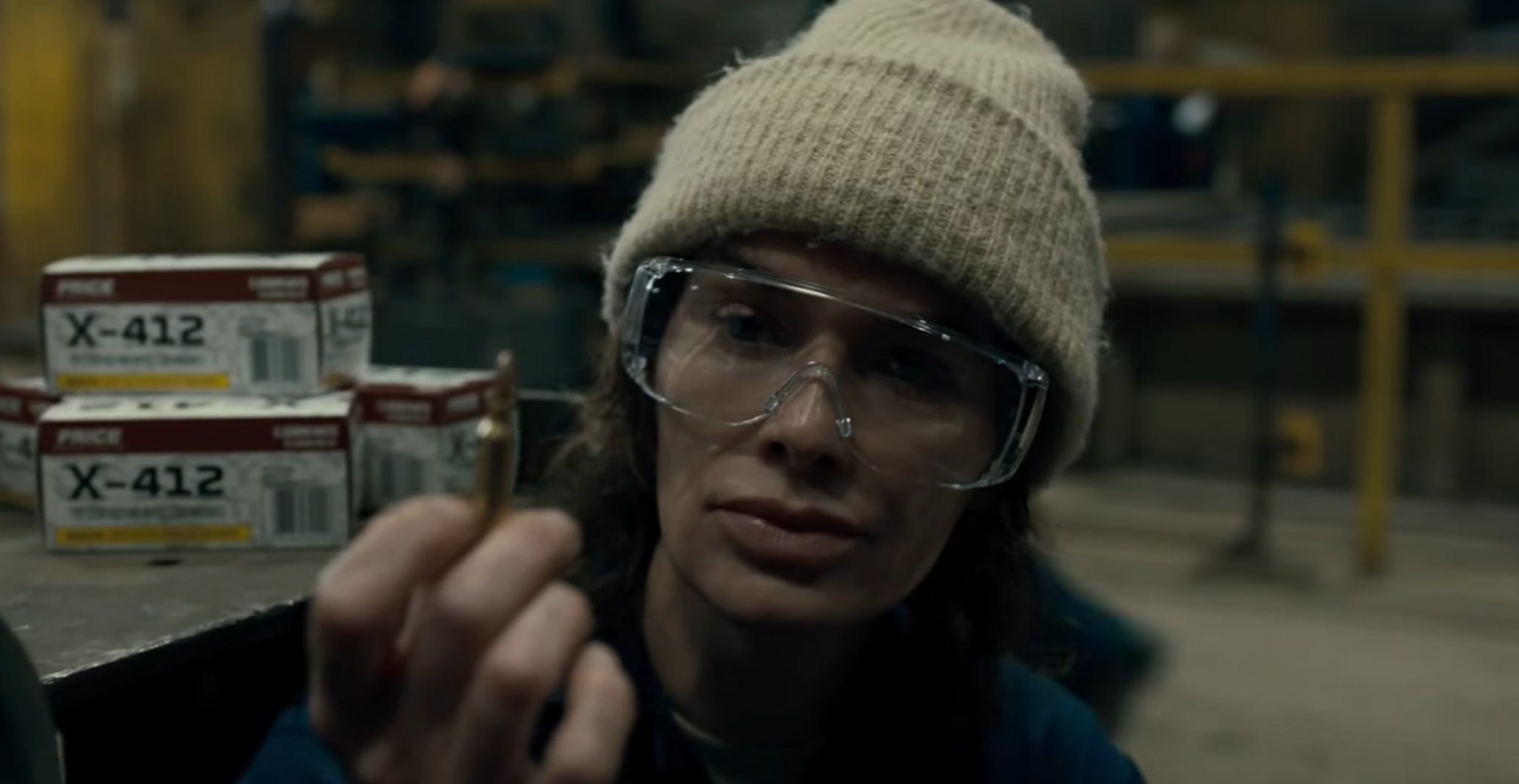
She is especially close to this loss because she works in a factory that manufactures bullets — specifically, the 5.56 rounds used by NATO in its excursions abroad. Day after day, she punches the clock for more drudgery watching the cartridges come off the conveyor belt, plucking them out for quality control inspection. It’s a crap job, but Nance is a blue-collar/red, white & blue type who doesn’t harbor any high ambitions for her own life.
Nance becomes convinced the round that killed Jesse was American — possibly even one from her own factory. She reads about how much ammunition the Taliban steals or illicitly buys from NATO (up to 30%, according to an end credits chyron) and starts down a long descent exploring anti-government talk radio, websites and video.
She becomes estranged from Diana (Amybeth McNulty), the daughter-in-law who is carrying her first grandchild, and does the same with her boss, Rick (Enrico Colantoni), one of those guys who open-carries everywhere he goes. They’re “kinda friends,” as he puts it, and he’s been needling her for a long time to come with him to the shooting range.
Nance does go, but on her own using an ancient bolt-action rifle from a bygone era. She finds an unexpected instructor and a sympathetic ear in Kahlil (Hamza Haq), a counselor from the military base who runs group sessions for bereaved families.
She didn’t dig the meetings — walking out after just a few minutes — but slowly warms up to the guy, despite his being from Afghanistan himself, a former translator who worked with the Americans. She buys an AR-15 just like his, an M9 Beretta too, and practices with an obsessive fixation that everyone but her sees is starting to get unhealthy.
They begin to form something like a friendship, as Kahlil owns a shared, similar trauma, though things remain always tense and on the edge.
“People like you do a much better job of hating Americans than I ever could,” Kahlil tells her.
Headey, best known for her masterful portrayal of Cersei on “Game of Thrones,” is convincing as an everyday, middle-aged lady who probably would have had a pretty uninteresting life without this tragedy, the sort who chain-smokes despite knowing the risks and votes party-line on her ballot. We’re afraid of Nance, but also afraid for her, and keep hoping she’ll turn toward the light.
She starts doing some truly scary stuff, like bringing a sharpened steakbone to her meeting with the Army bereavement officer (Amanda Brugel), and staking out the military recruitment office in town where Jesse first signed up.
Writer/director Chad Faust himself plays the Army recruiter, and they share an electric scene where Nance thinks she’s going to overwhelm him with her story of rage and blame, but turns out he has some hidden hurts of his own that will make her take a step back.
The rest of the movie isn’t always so on-target, though. Certain sequences seemed ginned-up simply to give Nance a place to go in her downward spiral, rather than somewhere she would have organically arrived herself. The transformation from all-American mom to potential serial killer happens too suddenly, without enough emotional layering to make the trip more believable.
I think it was also a mistake to only have Jesse in one scene with Nance (other than as a corpse in a casket), so he remains a sort of theoretical victim rather than a flesh-and-blood figure we cling to. A few flashbacks to fill out the borders of the relationship would’ve gone a long way. We get some montages of photographs of him as a kid, but it feels like just that: a snapshot album, standing in for something more substantial.
There’s a lot to respect about “Ballistic,” though I can’t quite get all the way to recommending it. It does a realistic job of portraying the weighty and real consequences for military families, but lands just outside the target rings in trying to turn that into a Hollywood narrative.