
Couture
Angelina Jolie headlines this avant garde rumination on women brought together for Fashion Week in Paris, where they have a range of intersecting experiences. Arty, but oddly compelling.


As a critic, I think it’s useful to the reader to admit any biases I might have going into a film. So let me just slap this on the table right away: I don’t give a flying fig about high fashion. In fact, I think the amount of time, money and energy put into things like Fashion Week in Paris and the Met Gala here in the U.S. is nigh unto criminal in its waste of resources better directed to… literally anything.
So I went into “Couture” without much enthusiasm. The fact that it’s an arty, avant garde French film didn’t put a lot of points on the board, either.
Despite this, I found the movie oddly compelling. Angelina Jolie headlines a cast of women working behind the scenes of Fashion Week who have a range of intersecting experiences. All of them will have their life profoundly changed, though in very divergent ways.
Written and directed by Alice Winocour (“Proxima”), I’m not sure if the film is trying to “say something,” but it’s more an observational piece about femaleness and in particular how its display is both a form of objectification and empowerment. For my part, I was swept up by Jolie’s performance and those of her castmates.
It’s an ensemble piece, but with unequally weighted roles. For instance, there’s a bit about a lowly seamstress, Christine (Garance Marillier), toiling behind the scenes, having to rip up extravagant dresses at the last minute because the measurements were off. She’s not important to the story, but adds some lovely context, such as plucking a strand of her own hair to weave into a garment for luck.
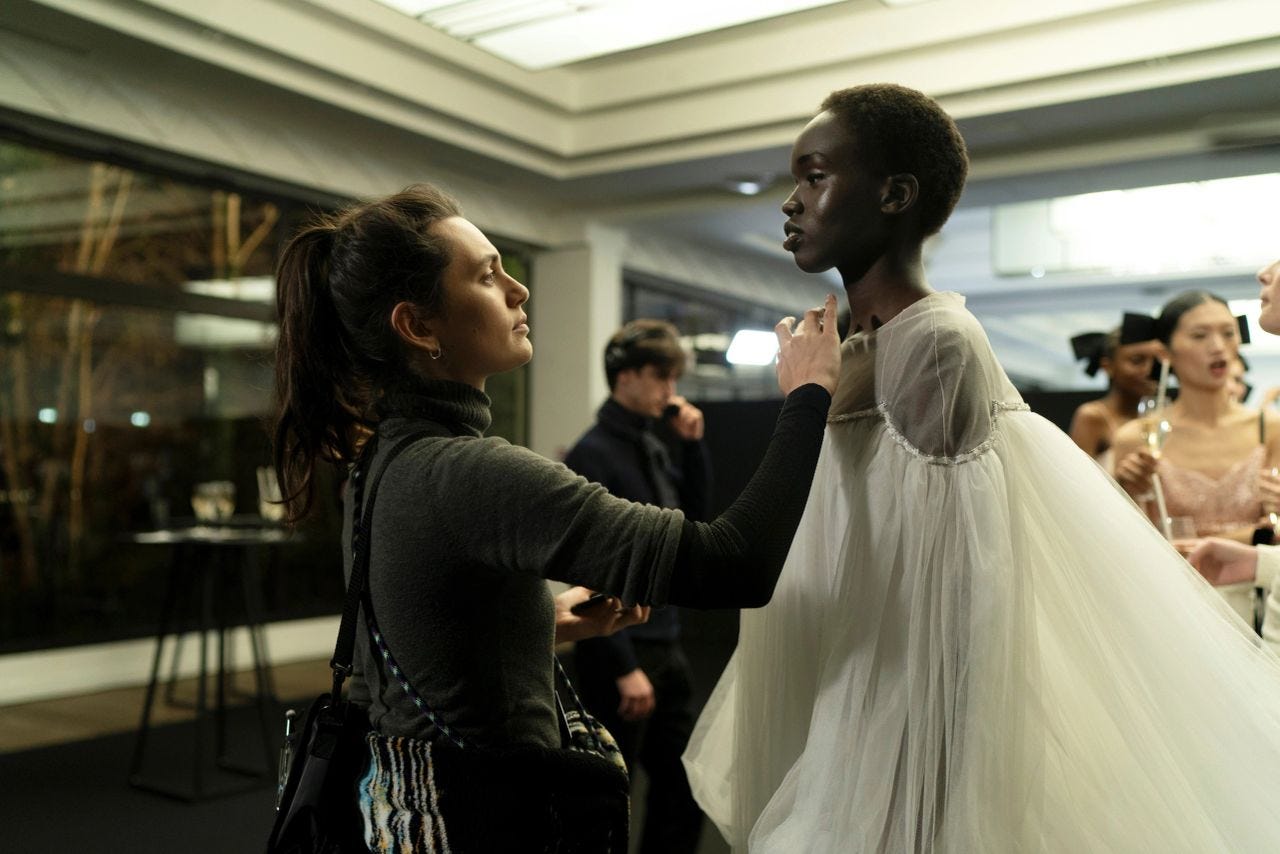
I’d say there’s three “main” roles: Jolie as Maxine Walker, an American filmmaker hired on to make a promotional film for the event; Ada (Anyier Anei), an 18-year-old novice model from South Sudan who’s given the prominent opening runway spot and is overwhelmed by this new world; and Angèle (Ella Rumpf), a makeup artist running around madly to make the women prettier, working literally head to toe, while secretly harboring dreams of becoming a writer.
There are more characters, of course — other models (Mona Tougaard, Mika Schneider, Nina Marker, Joana Preiss among them, all real-life models), a doctor (Vincent Lindon) and Anton (Louis Garrel), Maxine’s long-time cinematographer and friend. But they’re there to fill out the background and support the narrative journey of the big trio.
Maxine is jazzed about the gig, even if it’s commercial work. She’s made small indie films, mostly horror, and sees this as a stepping stone to enhance her reputation. In fact, she’s slated to start work on a new feature film a few weeks later. While in Paris, she gets some unexpected news that takes the wind out of sails. She reacts by trying to reconnect with her 15-year-old daughter back in the States, and by seeking solace in the arms of Anton.
Jolie is an interesting case study for Hollywood. She became arguably the biggest female star in the world, but didn’t seem very interested in that, and has worked intermittently the last dozen years or so on movies that sparked her creativity. Almost nobody saw her in “Maria” a couple of years ago, but I thought it an Oscar-caliber performance.
Her portrait of Maxine is a strong, smart woman who nonetheless is often performing for a world that doesn’t always feel very accepting. She gracefully bears the disdain and subtle controlling behavior of the mansplaining festival director and journalist interviewing her.
Ada has arrived from a culture that does not approve of displaying flesh, and in fact she hasn’t even told her father where she is. But the money this work brings in will support her entire family, including a teen brother with special needs. She’s a bit mystified by the other models, who aren’t exactly antagonistic but not terribly welcoming, either. She learns that it’s actually a lonely, exhausting gig where you traipse all over the globe but spend all your time in hotels or being fussed over like a mannequin.
Angèle was the most intriguing to me. She operates almost invisibly, toting around her rolling suitcase filled with makeup and equipment. She bitches about being cheated out of her pay for a recent job. But Angèle wants to be a chronicler of this strange universe, and has submitted a piece for publication that’s largely autobiographical, sort of a “The Devil Wears Prada” of the runway world. Rumpf gives her an almost palpable sense of yearning, of wanting to do more and be more.
All of the women will come into contact with each other at some point in the movie, though their narrative arcs are not necessarily dependent on each other. It’s almost like enjoying a very discreet, separate meal and then suddenly some of the food spills onto the adjoining plate, and you get to taste from that, too.
Supposedly “Couture” is the first movie ever to be shot at Chanel’s Paris showroom and atelier, which I guess is some kind of holy grail of fashion secret society. If you’re interested and impressed by that, then I’m happy for you; it’s just not my thing.
Mostly what I took away from this movie is reinforcing the belief that a story can be set in a world you care nothing about, but still engage and move you. But that also means sometimes a flick can seem right up your alley but leave you cold. Such is the appeal of the limitless hues and textures that form the threads of cinematic storytelling.
Fascinating review! I give equally few figs about high fashion, but I do enjoy arty French films and women-centered stories, so it sounds like this one should go on my watchlist.