
Cutting Through Rocks
An indelible portrait of a singularly scrappy, stubborn woman determined to force change in her deeply patriarchal Iranian village.

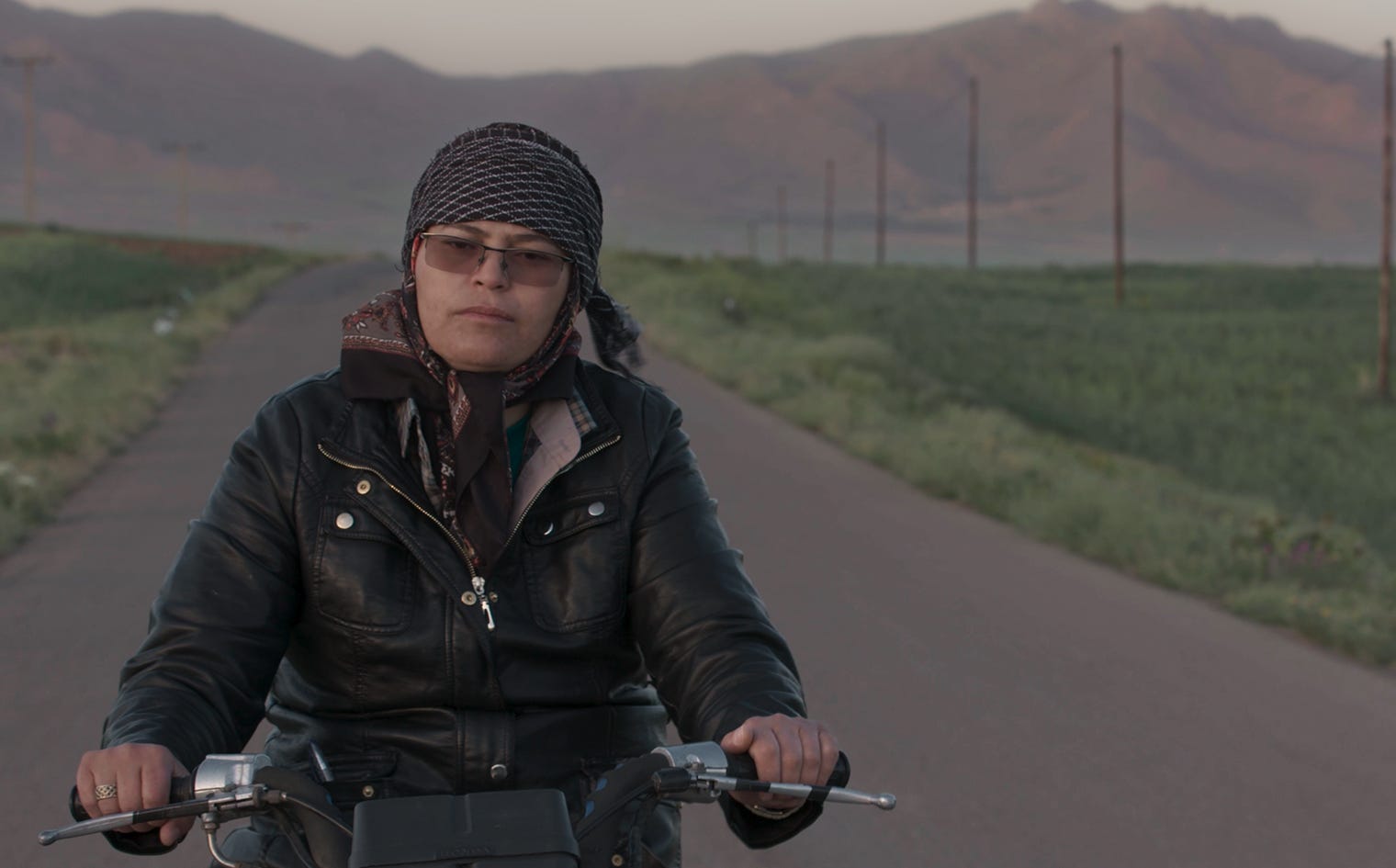

“Cutting Through Rocks” is not currently available to see in theaters or streaming, though it’s set to launch on the small platform DocPlay March 2. Normally I don’t like to publish reviews of movies until readers have some way of seeing the film, but I’m making an exception as it’s the last documentary feature nominated for an Academy Award that I hadn’t caught.
It’s a powerful and sobering look at a crusading woman who lives in a remote village in Iran, Sara Shahverdi. Riding around on a motorcycle, wearing pants and a militaristic cap, she cuts quite a figure as this loud, opinionated woman living in a patriarchal society not much changed from medieval times. Girls are expected to marry early (11 or 12 is not unusual), raise some children, cook for their husband and shut up.
Shutting up is not in Sara’s wheelhouse.
I guess you’d call her a proto-feminist, though I doubt anyone in her village — possibly even Sara — knows what a feminist is. A midwife by vocation, Sara’s main activity these days is teaching other women to stand up for themselves, choose their own path in life and claim something like respect, since equality seems a long way off.
Filmmakers Mohammadreza Eyni and Sara Khaki followed their subject around for a few years. At first Sara seems to make great strides, even getting elected to her village council. This is something that’s never been done before in the entire region, and the fact she gets the most votes of the five elected is a testament to the relationships she’s built over the years, not just with the women — many of whom she literally brought into this world — but not a few men, too.
Unsurprisingly, her upstart ways soon start to foment resistance from the local men, who take increasing steps to undermine her council work — such as changing plans for a children’s playground with out telling her — and even reporting her to the authorities for having a disreputable household.
She’s been divorced for 10 years, shocking enough, but is also raising a teen girl, Fereshta, protecting her from uncles who want to marry her off.
At one point Sara is forced to undergo medical examinations to prove that she is a biological female, with the prospect of having to undergo forced gender transition surgery to become a man. (A stark departure from our current arguments on that topic on these shores.)
With her broad face, omnipresent gap-toothed smile and sunglasses, Sara cuts a memorable figure. I’m sure seeing her cruise around the village on her motorcycle strikes some of the men with the same sort of picture 1950s American audiences had when Marlon Brando rolled up in black leathers in “The Wild One.”
Early on in the story she gets into it with her own brother, who rounded up and forced their five sisters to sign a legal agreement forswearing their portion of their father’s considerable inheritance. Of course he didn’t try to include Sara, but in this society the women felt like they had no choice but to accept their brother’s demand. He slaps Sara around but she refuses to give in, and the offending document is ripped up.
After her election, Sara becomes something of a celebrity to the young girls in the area. She visits a school, encouraging the young women to sign a pledge to wait until they’ve had an education to marry. Later on, she’ll look back on the photo of this group and start counting off the sad, small number who were able to keep their promise.
At one point we meet Zahra, a vibrant girl who confesses her desire to use Sara as a role model. Sara takes them out for a motorcycle ride through the country, but things turn sorrowful when they get to the main village streets where men can see them.
Interestingly, Sara’s desire to be different, even rebellious is something she learned from her father, who died when she was 16. It was he who taught her to ride motorcycles, and together they planted two trees in the middle of a desert plain outside the village. Whenever she’s feeling challenged or faltering in her quest, Sara visits this quiet little oasis from the patriarchy of her home.
As one must often do today in assessing a documentary, I wonder how much of the footage was simply recorded following Sara doing what she does, and if certain scenes or shots were set up. A signature moment, a very cinematic scene were Sara rides into the frame and halts before a setting sun on the horizon is too perfect not to be the latter.
But I never got the sense Sara was performing for the camera — or indeed if the idea of doing so even occurred to her. She’s a singularly scrappy, stubborn lady who seems to instinctively resist that which she thinks wrong in her Iranian society, which is a lot. Men in general seem to have a problem with women like Sara, no matter where they reside. Even rocks eventually sunder and split.
This is the last one I need to catch as well. Reminder set for the release on that platform you mentioned.