
Dreams
Oscar-winning actress Jessica Chastain slums in this impotent erotic thriller about a privileged woman using a poor immigrant dancer as her plaything.

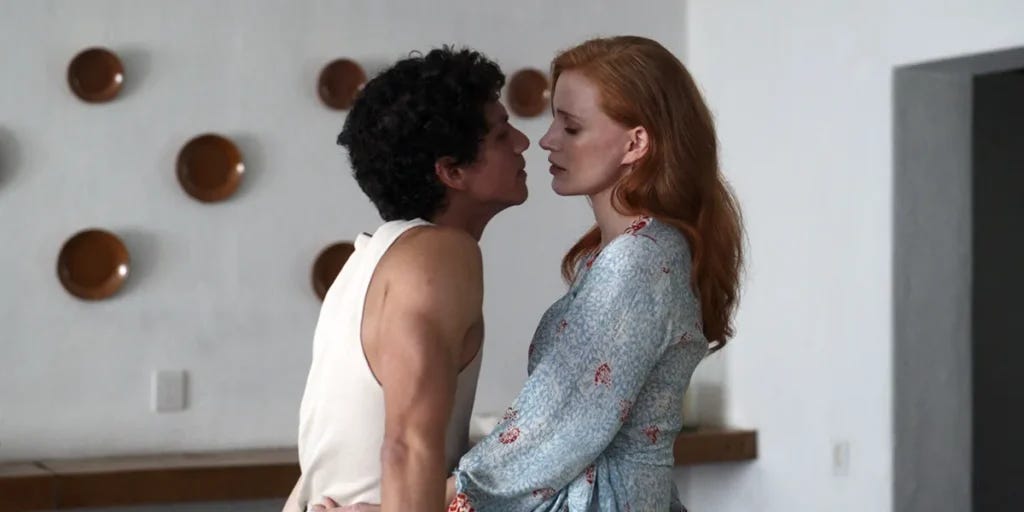

There’s an old saw in Hollywood that actors shouldn’t work with children or animals — the idea being that either they’ll steal the limelight or be so miserable to work with it degrades your own performance and standing.
Perhaps there should be a corollary: if you’re a thespian at the top of your game, working opposite neophytes isn’t good for you, or them. An inexperienced actor next to a master will suffer by comparison. And even the master looks worse for wear in not striving with costars that at least approach their level of craft.
Case in point is “Dreams,” a new erotic thriller starring Oscar-winning actress Jessica Chastain. Since nabbing that Academy Award for “The Eyes of Tammy Faye,” Chastain hasn’t made any great waves artistically or at the box office, appearing in middling fare like “The Good Nurse” or shining in “Memory,” a tiny film almost nobody saw.
She plays Jennifer McCarthy, daughter of a wealthy family of San Francisco philanthropists, the sort of folks who put their name on buildings and luxuriate in a privilege most of us couldn’t even imagine. Rupert Friend and Marshall Bell play her brother and father, whose pet passion is funding the arts — museums, dance companies and such.
Playing opposite Chastain is Isaac Hernández as Fernando, a penniless ballet dancer from Mexico. He and Jennifer previously met and fell for each other as she funds a dance academy in Mexico City. As the story opens, Fernando has made his way illegally into the U.S. in order to pursue his dancing dreams and continue his affair with Jennifer, apparently against her wishes.
To recognize there’s an imbalance in their power is an understatement. He literally arrives with nothing, not even a whole shirt, walking the last miles through the desert in a tank top. But he finds his way to Jennifer, and they have some steamy sex scenes together.
“I want to take care of you,” she coos. But Fernando starts to see that as a form of control and essentially runs off. He works odd jobs — motel cleaner, bartender — while busking his dancing skills on the streets. This attracts the attention of the artistic director of the big San Fran ballet company, where of course the McCarthys are big patrons.
Brought back into Jennifer’s orbit, they resume canoodling but now it’s she who grows resentful. Things eventually wind up back in Mexico City, and without giving anything away Fernanco tries to turn the tables on Jennifer in a malicious way.
There’s a big age difference between Jennifer and Fernando, I’m guessing a couple of decades. Hernández is a real-life ballet dancer who’s 35 but looks closer to 20. This earns a lot of judgment from others, including Fernando’s parents and Jennifer’s fellow bluebloods.
I’m not sure if Jennifer is truly a bad sort, but she’s grown up with immense entitlement and is incapable of seeing past that. I’ve had my own occasions to rub elbows in a professional capacity with a billionaire or two, and even the altruistic ones have a tendency to become confused when the people around them don’t just automatically do whatever they want.
For example, at one point Jennifer has finally agreed to go on a public date with Fernando, and she gets very annoyed when he converses with the waiter in Spanish for maybe a minute (which she never bothered to learn, despite her outreach south of the border). “Didn’t mean to interrupt your conversation,” she snorts.
With regard to Hernández, I’ll say this: He dances very well. As for his acting… well, he dances very well.
Whenever he and Chastain are vertical on screen, their dialogue scenes come across as achingly flat and listless. There’s surprisingly little information passed between them that carries any clues to their emotional involvement. In fact, Fernando really comes across a cypher, hard to understand other than as a purely carnal presence.
It’s not all the actor’s fault. Writer/director Michel Franco, who also worked with Chastain on “Memory,” has given us what feels more like the sketch of a passionate story than the whole flesh-and-blood thing. We see a lot of outward behavior but not much in the way of interior motivation. There is ample flesh on display but not the beating hearts beneath it.
It is possible for a seasoned actor to pair well with a novice, particularly if they’re playing parent and child or some other dynamic where the more experienced thespian can take the lead. But in “Dreams,” it’s supposed to be a matchup of equals — and that just isn’t the case here.
Iron sharpens iron, and all that. Against clay, one crumbles and the other just gets soiled.