
H is for Hawk
A professor turns to training a killer goshawk as a way of dealing with the trauma of her father's death in this affecting based-on-true story.


Having seen my fair share of trauma, one thing I’ve learned is that everybody has different ways of coping with it. Some people turn to art or poetry. Others quit their toxic job or relationship. Some even buy 20-foot metal behemoths. It’s about whatever works.
Sometimes, though, the things we turn to in times of loss or mental health challenges can make things worse, or at least misdirect us from dealing with our grief. That’s the premise of “H is for Hawk,” a based-on-true story of a professor who copes with the death of her beloved father by training a goshawk, a killer bird of prey that consumes all her attention and indeed begins to overtake her identity.
It’s a spare picture, elegiac in tone and confrontational in its look at the sort of bone-deep depression that never really goes away, but at best becomes a manageable part of a person’s psyche.
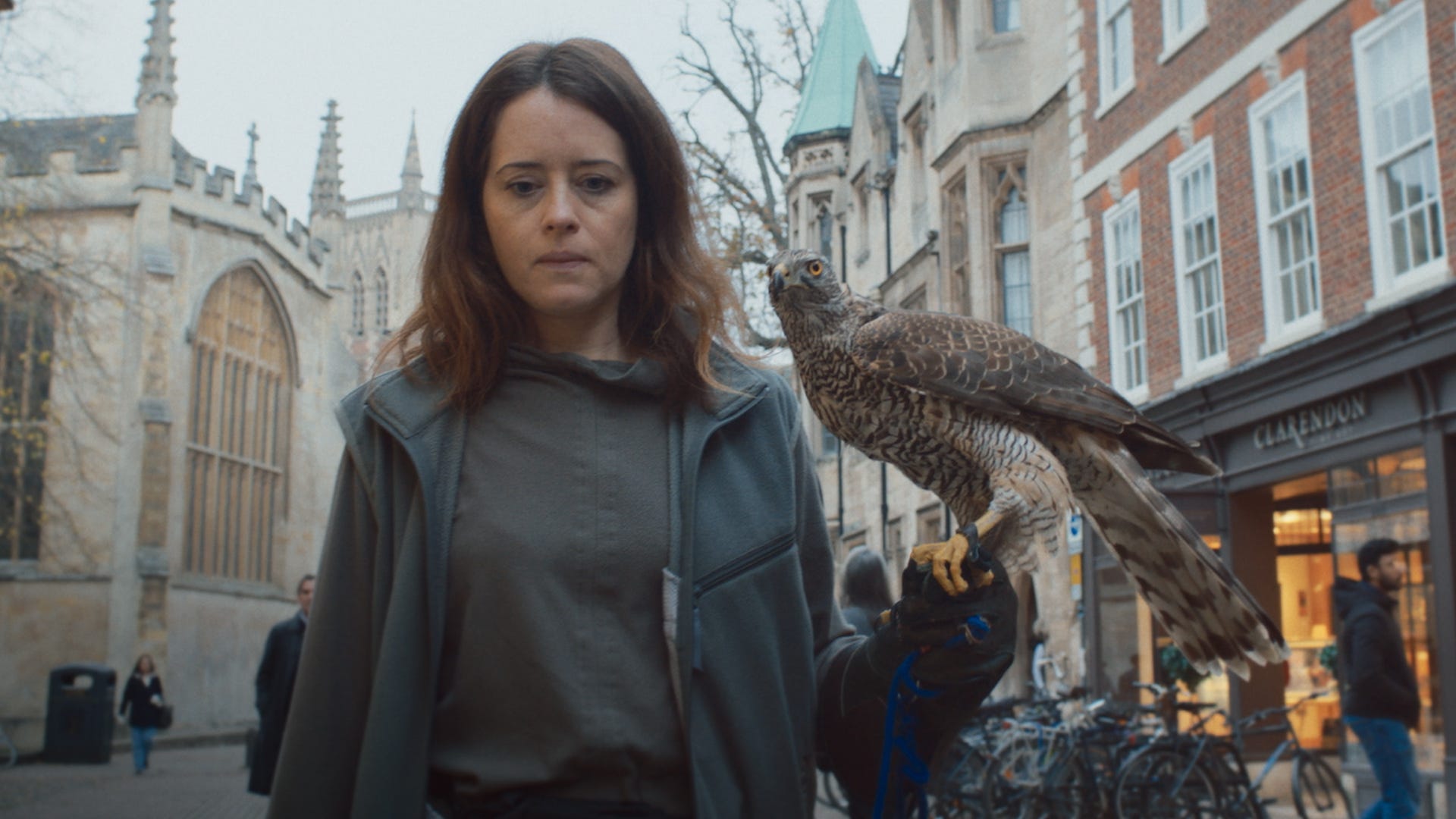
Based on the autobiographical book by Helen Mcdonald, it stars Claire Foy as the author, a middle-aged fellow at Cambridge who is at a crossroads in life.
She’s been offered a prestigious position in Germany, but doesn’t want to leave her native England. Indeed, her entire zeal for academia is frayed. The latest in a string of sporadic relationships has sputtered to an end. The end of her fellowship housing means she’ll have to find a new place to live.
If she was feeling stuck before, the death of her pa leaves her transfixed with grief. Played by Brendan Gleeson, Alisdair is seen mostly in flashbacks, snippets of memory by Helen that show how similar they were. He was a photojournalist who captured iconic images of the last 50 years, including a personal project to photograph every bridge spanning the River Thames.
Both introverted thinkers with a mordant senses of humor, they were drawn to each other’s love of knowledge and the natural world, especially all manner of birds but particularly carnivores.
Helen had trained with hawks as a youngster, and finds herself transfixed by the idea of getting a goshawk as some sort of tribute/stand-in for her dad. Goshawks are notoriously difficult birds to work with, avoided by even those at the expert levels of falconry. (This term is used to cover the entire sport of birding, though as we’ll learn falcons and hawks are, to those who keep them, as different as cats and dogs.)
Do you want to know the trick for keeping a goshawk, asks the breeder who sells it to her? “Murder. Calms them right down.”
Helen dubs her hawk Mabel, a commonplace name for an extraordinary creature. Unlike falcons that take their prey high in the air, goshawks are like a helicopter gunship, cruising low and navigating through dense brush to capture other birds or varmints. The photography (by Charlotte Bruus Christensen) is quite startling at following Mabel through flights like this, tucking her wings at just the right split-second to maneuver through an opening barely wide enough for her body.
The story (screenplay adaptation by Emma Donoghue and Philippa Lowthorpe, with Lowthorpe also handling directing duties) tags along through the predictable getting-to-know-you sequences, where Helen gradually bonds with Mabel and vice-versa, suffering the expected setbacks. At first thinking she’s made a terrible mistake, Helen turns to her ex, Stu (Sam Spruell) for advice and support.
Helen begins taking Mabel with her wherever she goes, becoming quite the curiosity around Cambridge with the goshawk perched upon her arm like a frozen statue of aggression.
Over time, though, the relationship between woman and bird becomes all-consuming, and Helen finds herself unwilling to leave her apartment, other than to go hunting with Mabel. Her best friend, Christina (Denise Gough), tries to be there for her but finds herself continually shut out — quite literally, as Helen hides when her pal comes knocking.
Eventually she’s missing classes she’s supposed to teach and ignoring her mum’s (Lindsay Duncan) requests to help prepare for her dad’s service.
She even forgets about a seminar she was scheduled to give — ironically, about how her relationship with Mabel is a more honest encounter with the natural world. She’s so consumed with being beside her hawk, and thinking about her dad, that she neglects to talk to other people about these attachments.
Foy makes for an empathetic presence, even as we feel Helen sliding again and again into harmful behavior. She’s never overtly cruel to others, but from the outside her fixation with her goshawk — even letting her appearance and apartment fall into squalor — clearly seems like obsessive, even addictive modes of personality.
Director Lowthorpe comes from a television background, working with Foy on “The Crown,” and as sometimes happens the pacing for a feature-length film feels like a standard hour show that has been pulled and stretched to double that. There are many scenes of Helen ensconced in her apartment, curled upon the ground doing nothing but staring at Mabel, that could have been imparted with equal emotional impact over lesser screen time.
“H is for Hawk” is not one of those movies that treats grief and depression as a disease that can be cured, perhaps with a new love or an animal companion. When people are in pain, they can find themselves yearning for any kind of distraction, even one that impacts their life negatively — trading one trauma for another.
It’s a challenging portrait of feral grief.
I saw this at the London Film Festival. Really good.
.