
Jay Kelly
George Clooney and Noah Baumbach team up for a wistful, self-referential portrait of an aging Hollywood star looking back on a life of wild success and bitter regret.

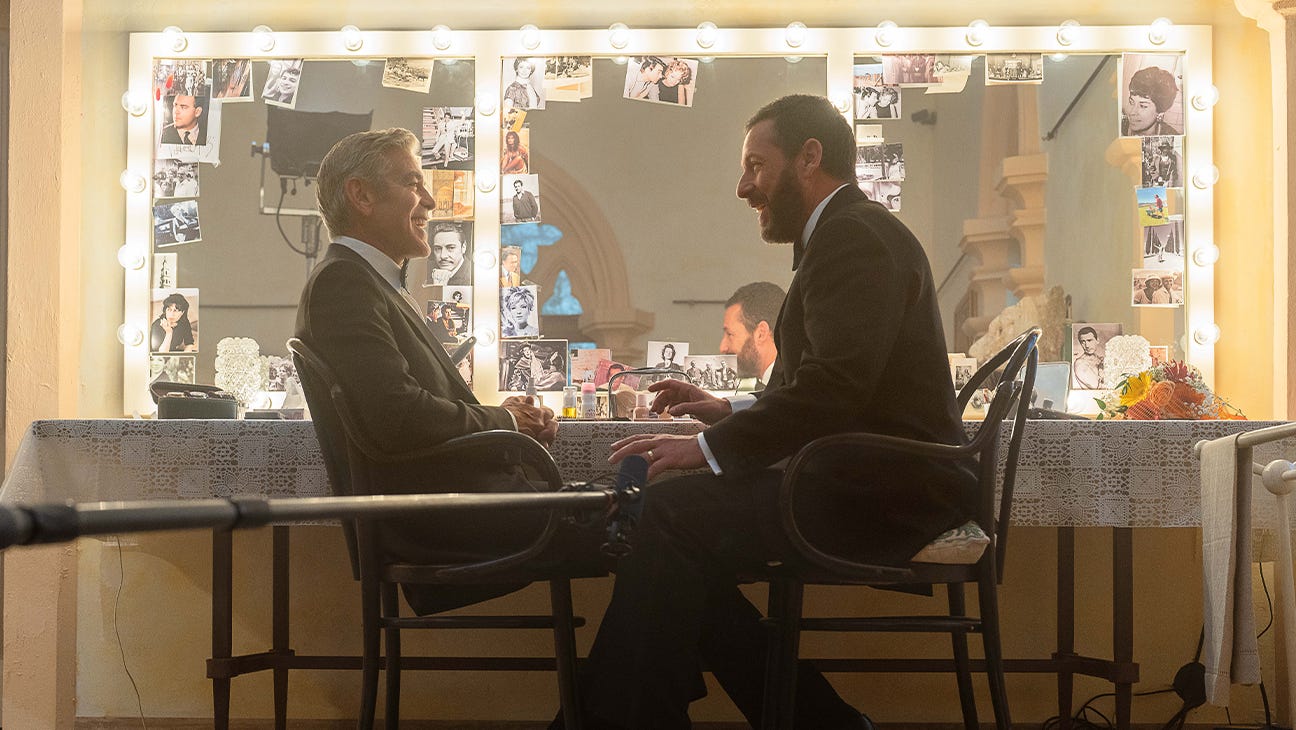

“All my memories are movies.” — Jay Kelly
I suppose the question a lot of people are going to ask about “Jay Kelly” is, “How much of this reflects George Clooney’s real life?”
I understand it. Jay and George are both 60ish, dazzlingly handsome movie stars with killer smiles that betray just a touch of self-reproach. Chin tucked down, eyes flashing impish charm, it’s a look that says, “I can’t help that I’m this damn good-looking and talented, and won’t apologize for making the most of it.”
My take is the premise is just as fake as Jay: a cinematic charlatan. The portrait of an egotistical ham who’s looking back on a life of wild success and bitter regret, it requires someone at Jay’s level for the role to work. So, it’s not about Clooney, but only Clooney could play it.
(At least, at this particular point in time. In 1965, only Cary Grant could’ve done it.)
Directed and co-written (with Emily Mortimer) by Noah Baumbach (“Marriage Story”), the film is both a celebration and indictment of movie stardom. Jay is a guy who’s not any more talented than every other actor, but he’s got a certain look and a way of always seeming authentic when the spotlight’s on.
They say actors play many roles but movie stars always play themselves. Jay is among the best at playing himself — even if he’s forgotten who that guy is.
As the story opens Jay is wrapping one movie and set to start another. His 18-year-old daughter, Daisy (Grace Edwards), is about to leave on a summer trip of Europe with friends before college. His older kid, Jessica (Riley Keough), barely wants anything to do with him, returning the indifference he showed her growing up.
People like Jay move about with a small army of hangers-on and ass-kissers in tow. Chief among them are his manager, Ron (Adam Sandler), and publicist, Liz (Laura Dern). They have been with him for 35 years, and both their professional and personal lives revolve around servicing Jay, while convincing themselves they are his friends rather than employees.
(As we’ll learn, they also once had a personal connection they abandoned to the cause.)
After the funeral of the director (Jim Broadbent) who gave Jay his big break, Jay bumps into an old acting buddy, Tim (Billy Crudup). They go out for drinks to catch up on their glory days, but it turns out Tim bears a deep resentment of Jay and things end poorly.
You ever heard that (fairly common) showbiz tale of young actor who tagged along to a friend’s audition, and ended up getting the part themselves? Tim demands to know why nobody ever asks what happened to the friend.
This event causes some kind of break in Jay’s psyche, and he immediately decamps aboard a jet to Paris with his entire entourage. Ostensibly it’s to accept a tribute at an Italian film festival — which he had at first haughtily refused, forcing Ron to un-cancel the honor. But really he wants to stalk Daisy, “surprising” her by happening to climb aboard the same train.
The whole train sequence is flat-out terrific. Everybody onboard is astounded at a huge movie star riding alongside the plebes, and they shower him with attention and compliments. Jay laps it all up, of course, even inviting everybody in his car to the to-do in Tuscany. In contrast, his meeting with Daisy is harsh and heartbreaking.
He thinks he’s doing her a favor — to Jay, everything he does is doing somebody a favor — but can’t see he’s smothering the kid.
“How can I play people if I can’t see people… touch people?” Jay begs of Ron.
Interspersed with the journey are flashbacks to pieces of Jay’s life. An early on-set romance with a co-star. Watching his daughters do backyard revues. An acting teacher warning of the danger of becoming a famous actor: it’s twice as much work because you have to play the part and play the guy playing the part.
I think in concept Ron is supposed to be an equal lift to Jay, and the story is meant to be about the slow fracturing of their relationship. In practice it doesn’t play out that way. Sandler is solid and sympathetic as the long-suffering guy behind the scenes, the one who arranges and fixes so Jay can always look his best.
But all the momentum is with Jay, and he’s got the more compelling angle. As in their business arrangement, Ron will always be there to support the star.
It’s impressive how “Jay Kelly” can wrap so much tragedy into a movie that is often raucously funny. There’s so many little throwaway jokes and small ironic moments. Like the fact Jay is greeted by a slice of cheesecake wherever he goes, a vestige of some long-forgotten rider clause, when he actually hates the stuff.
Baumbach shoots the movie like Robert Altman movies of the 1970s, with many characters moving through space as interlapping conversations fade in and out of the background. There’s tons of lovely bit parts for recognizable actors, including Mortimer, Stacy Keach as Jay’s dad, Josh Hamilton as a cloying therapist, Greta Gerwig as Ron’s wife, and Patrick Wilson as another, lesser client of Ron’s about 15 years behind Jay’s trajectory.
Needless to say, Clooney owns the whole enterprise like the megawatt star he still is. He plays Jay as a very flawed and in some ways thoroughly empty guy, and yet we can’t help liking him and feeling empathy for his many foibles and failings. He’s a hollowed-out man we would like to see filled up again.
Clooney doesn’t make very many feature films these days, probably because he doesn’t want to or need to. Then he’ll pop back on the scene with something light and frothy like “Ticket to Paradise” and remind us why he is one of the few remaining true movie stars.
In contrast, “Jay Kelly” is a lot more serious in intent, despite all the joking. It’s self-referential to George Clooney’s stardom without being about that. It tweaks Hollywood ridiculousness while reveling in its twinkly aura. It’s got charm, and gravitas — a killer combo.