
Jimpa
An affecting, offbeat family drama glimpsed through the prism of queerness, starring Olivia Coleman and John Lithgow as a daughter and father navigating their scratchy past and vanishing future.

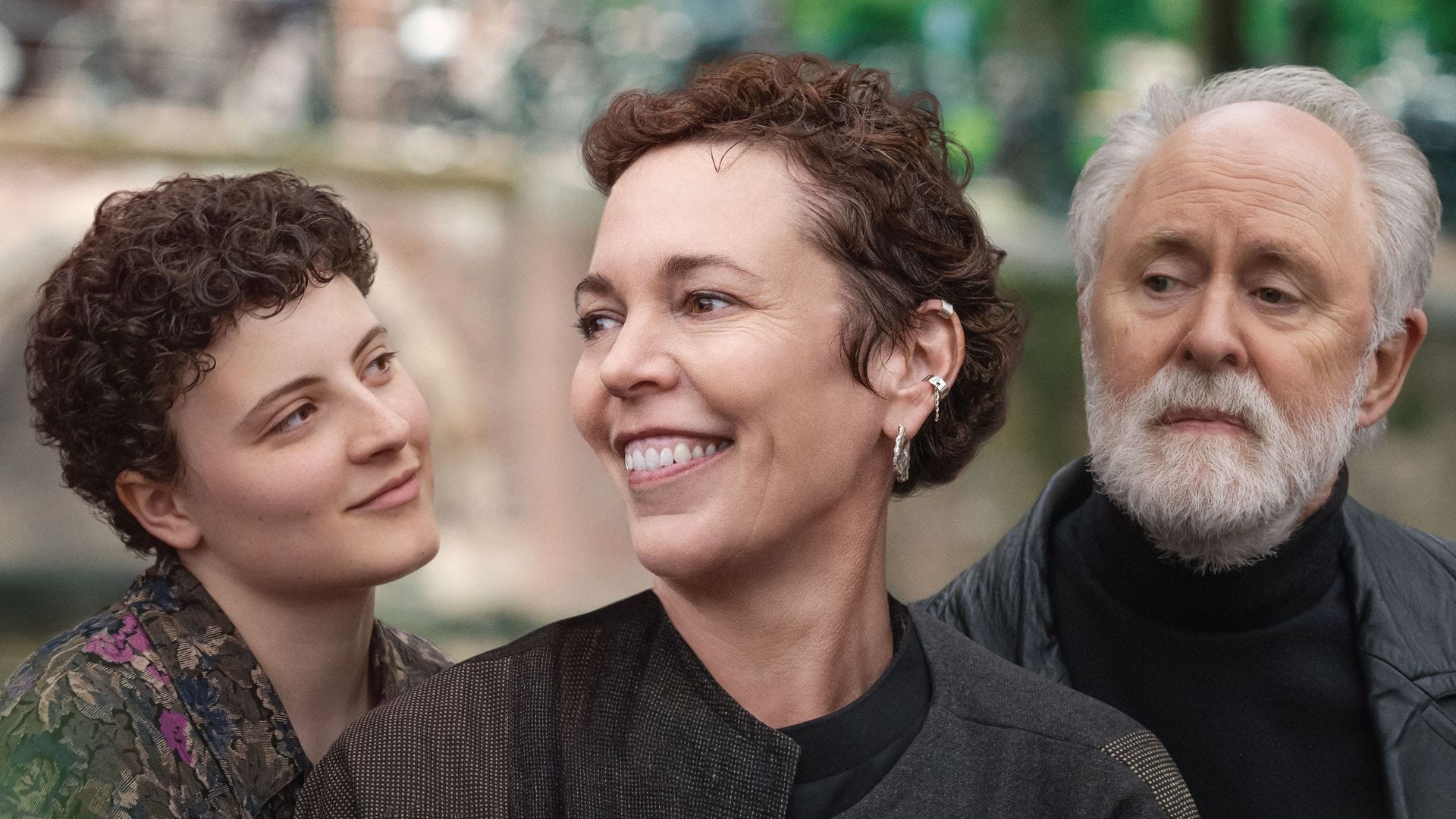

“Jimpa” will see limited release in New York and Los Angeles starting Feb. 6, with wider distribution TBA.
“Jimpa” is a very different sort of family drama, though it contains a lot of the pieces we’re familiar with: an aging, iconoclast patriarch; the middle-aged child still coming to grips with their relationship; a grandkid searching for their place in the world who’s stuck in the middle between their forebears. Layer in some health scares and career/legacy jitters, and you can probably find a couple dozen of this sort of thing currently on streaming services.
(The Oscar-nominated “Sentimental Value” being a good, recent example.)
What makes it different is that it’s a familiar dynamic glimpsed through the prism of queerness. The titular dad, Jim (John Lithgow), is extravagantly gay and a human rights activist. His daughter, filmmaker Hannah (Olivia Coleman), is bisexual and non-monogamous. Her child, Frances (Aud Mason-Hyde) is nonbinary and attracted to women, their birth gender. Nearly all of the supporting characters are on the LGBTQ panoply.
It’s directed by Australian filmmaker Sophie Hyde, who co-wrote the screenplay with Matthew Cormack, a collaborator on “52 Tuesdays.” It’s a semi-autobiographical work and Mason-Hyde is her own real-life child.
I really dug Hyde’s filmmaking aesthetic. It’s got a very authentic, naturalistic feel, and she will often cut away from what we’re seeing to illustrate what the characters are talking or thinking about, such as long-ago events or something more recent. So for example, instead of having devoted flashback scenes to Hannah’s childhood with her dad, we’ll see little glimpses, really just snippets and vignettes, of those memories.
The effect is to give the characters added dimension and weight, as we feel we’re experiencing the totality of their life and emotions, rather than where they are in the now.
Jim came out as gay shortly after marrying Hannah’s mother, but rather than breaking up they created a new sort of bond centered on their devotion to their two daughters. (Kate box plays her older sister, Emily.) Eventually, though, Jim’s desire to live more freely and pursue political advocacy on behalf of gay rights led him to move from Adelaide in the south of Australia to Amsterdam when Hannah was 13. It was a geographic but not emotional abandonment.
At least, this is the story Hannah has told herself all her life about her parents. She’s now trying to get production of a film about them off the ground, and comes to Amsterdam with Frances and her husband, Harry (Daniel Henshall), to visit her dad and (eventually) tell him about the movie she’s planning. She and Jim have a very open and loving relationship, though they tend to talk around subjects that are near and painful.
The potential producers and actors she pitches to via video meetings don’t seem terribly excited about the project: “a drama without conflict.”
A few other issues intrude. Jim had a serious stroke three years earlier and still isn’t quite in the clear. He’s about to retire from his position at university, and Frances is floating the idea of living with “Jimpa” while they finish school. Though they feel accepted at school in Australia — even acting as president of its LGBTQ club — Frances believes they need to open their horizons in a very accepting, cosmopolitan city like Amsterdam. Some initial outings with some teens in Jim’s orbit only serve to reinforce this desire.
(Interestingly, we never hear Dutch being spoken, and the cast’s Australian accents tend to come and go.)
Hannah likes the idea of someone being around to watch over her dad, but Frances is still 16 and a mother worries. Harry shares those concerns — though the part is so tragically underwritten, the husband is a complete non-entity to such an extent it would have been better to have written him out of the film.
It’s some very splendid acting from Coleman and Lithgow, playing people who seem very much the captains of their respective ships, but we sense the anxiety and doubt underneath. Jim is a charismatic, loquacious guy but tends to have a blind spot about how his strong opinions can come across as passive bullying.
Some of the most memorable scenes in the movie are conversations in which Hannah and Frances are included with Jim’s extended circle of friends, mostly older gay men like himself. Jim rejects the idea of bisexuality as simply someone being a wishy-washy squish, and even seems a mite obtuse about transgenderism. The generational differences between Boomers and Gen Z can be quite stark, such as the older set’s rejection of the term “queer” as a slur, while Frances embraces it.
Nevertheless, Jim is openly loving to Frances and celebrates their journey, referring to them as “my grand-thing.” It’s an example of his friendly, teasing manner that can come across as condescending and out of touch.
The last act of the movie goes through some pretty predictable paces, though always in a way that generates huge stashes of empathy for these characters and what they’re going through.
There’s some risque sequences, such as Jim’s jaunts through underground gay clubs and his general penchant for nakedness, and props to Lithgow at age 80 for proudly flaunting all he’s got — without any of the coy camera angles usually employed for this sort of thing.
I suppose the family depicted in “Jimpa” will seem odd and “other” to many people — myself included — and even depraved for a certain segment that almost assuredly won’t go to this movie anyway.
What I saw was a vibrant, loving portrait of a family more fractured than they are willing to admit, trying and often failing to fill in those cracks. No matter where you come from or who you love, you can’t deny the fulfilling warmth that radiates from this picture.
Chris: You had me at Lithgow and Coleman. Sounds like another entry to my most-see list.