
Kokuho
Two actors spend decades vying for attention and affection as kabuki players in this visually sumptuous Oscar-nominated drama from Japan.


That’s it — we made it. I completed my quest to see every film nominated for an Academy Award prior to this year’s ceremony March 15.
I’ve no idea what I got such a bee in my bonnet to make a full sweep this year. Certainly it proved more challenging than I would have thought, even for someone who watches lots of movies.
“Kokuho,” nominated in the Best Achievement in Makeup and Hairstyling category, turned out to be my white whale. I spent weeks tracking down a press contact to get a screener for the movie, which isn’t yet widely available in theaters or on streaming platforms.
And then I found it was a 3-hour-long drama about, of all things, Japanese kabuki theater. Specifically, the decades-long struggle between two actors vying for attention and affection as Onnagata, aka men who specialize in playing women.
I aim to be culturally open-minded but admit certain things are not my bag: Western opera. Free-form improvisational jazz. And Japanese kabuki is on the list, too.
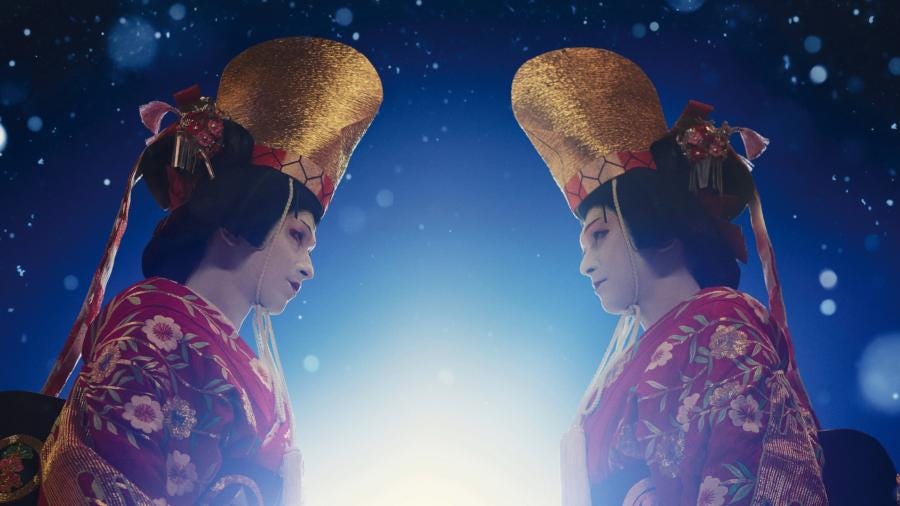
It’s just just an arch, highly stylized art form, with the actors slathered in alabaster makeup, puffed up in big kimonos as they move through intricate dance moves caught somewhere between ballet and yoga poses, accompanied by percussive, repetitive music.
Call me a philistine if you want, but for me a little of this stuff goes a short way.
(There’s a reason “kabuki theater” has become a derogatory slang term for political posturing.)
So I was as surprised as anyone to be delighted by “Kokuho,” which roughly translates as “living national treasure.” Yes, at 174 minutes it’s longer than it needs to be. And I found myself losing patience when the kabuki sequences went on too long.
But it’s a wonderful human story, well-told and empathetic, with an underlying theme of how fully devoting oneself to art often means sacrificing everything else in your life.
And the makeup and hair is, even if you’re not an aficionado like me, quite splendid. Artists Kyôko Toyokawa, Naomi Hibino and Tadashi Nishimatsu not only had to do the actors up in their full regalia, but also in many in-between stages as they prepared to go on or come off the stage, and are even seen meticulously applying the makeup themselves.
It’s the story of the rivalry between Kikuo (Ryo Yoshizawa) and Shunsuke (Ryusei Yokohama), who are almost like brothers as teens but grow into deep, bitter antagonists as the years go by and their fortunes in the kabuki trade wax and wane. In some ways it reminded me of “1900,” Bernardo Bertolucci’s grand, flawed epic about a similar Italian feud.
Kikuo was the son of a yakuza (mob) boss who is killed by rivals in 1964. Showing an early aptitude for onnagata acting, he is taken in by a respected master, Hanai Hanjirom, played by Japanese screen icon Ken Watanabe. His own son, Shunsuke, is the same age and the two soon bond as they train together under Hanai’s stern hand. They make their major debut at a young age playing duo maidens, and become a great success.
(Sōya Kurokawa and Keitatsu Koshiyama play the roles as youths.)
Kikuo, blessed with a diminutive form and lovely, androgynous features, soon begins to outpace Shunsuke in the art. When Hanai is injured and unable to perform, he selects his apprentice rather than his own son to take over — not just this role but eventually adopting his stage name. It’s a great dishonor for Shunsuke, and he disappears for years — taking Kikuo’s erstwhile girlfriend, Harue (Mitsuki Takahata), with him.
The story — screenplay by Satoko Okudera, based on the novel by Shuichi Yoshida — reunites their stories several times as time goes by. Shunsuke reemerges as a self-effacing media figure, while Kikuo is consigned to supporting roles as public opinion views him as an unworthy usurper. But their places will switch again, and then again.
It is a curious thing that in traditional kabuki, all the roles are played by men (as much was the same in early forms of Western theater), even though it was actually created by a woman. It’s perplexing how Japanese culture regards the onnagata, with men in the audience openly praising their beauty and even transfixed by them as sexual objects, yet there’s no hint of homosexuality in these characters.
Chalk it up to dudes to get into fistfights over who’s better at pretending to be a girl.
Director Sang-il Lee’s pacing is sometimes rather slow, though it’s difficult to collect all of a 50-year sweep of events into a cohesive movie. Despite the run time, I also felt the female characters were neglected in the narrative, pushed almost to nonexistence out of the storytelling. (Just like in kabuki.)
What I most appreciated about “Kokuho” was the intense emotionality of it. I may not have understood why these made it their life’s work to portray women in kabuki, but you can’t deny their willingness to give everything they have to their craft.
And perhaps therein lies the answer to my own errant quest.
Congratulations on making it through the Oscar viewing project ... and this film! Achievements both