
LifeHack
Tech-savvy but teenage-dumb, a group of hackers decide to steal $25 million from an arrogant billionaire in this anxiety-inducing heist flick that takes place entirely on screens.

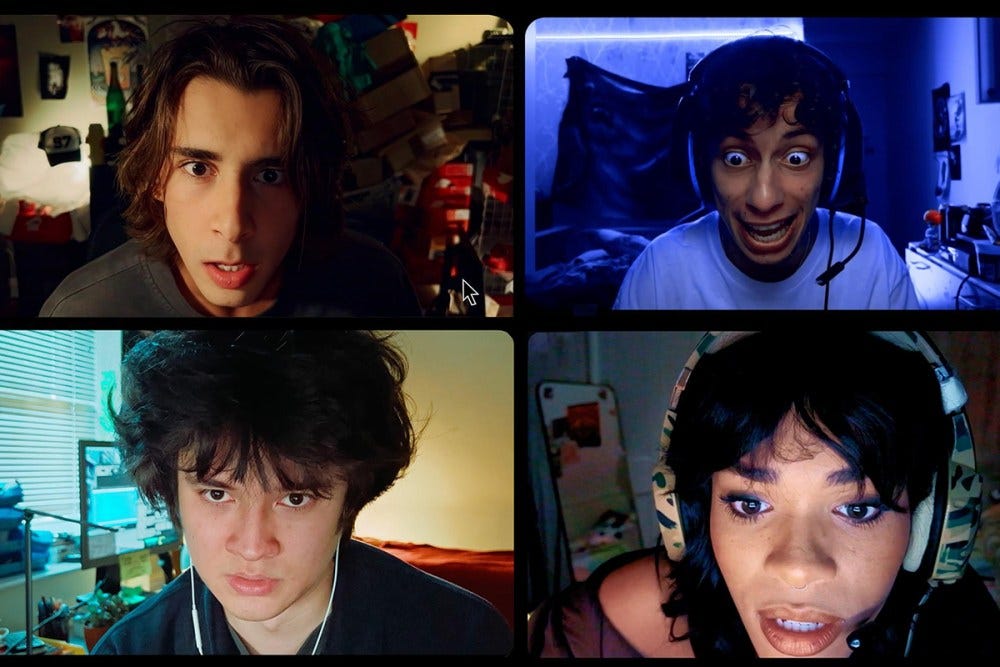

I’m trying to remember the first movie I saw that took place entirely through screens — as in there’s no standard shots of people and things moving about their organic environs, but we only view them through their various computer and device screens. Like a Zoom or Google Meet as an entire movie. I want to say the late 2000-teens.
There’s been a few now, so “LifeHack” doesn’t feel quite so groundbreaking as a reflection of an everyday life for many of us.
Like yesterday, when I stared at a computer screen for nine hours for work, then for a couple more for personal email and writing and stuff, and then I watched this movie on my laptop, and then a little of “The Boys” Season 5, and then some random dinking on my phone before bed. Screens are where we live now, for better or for worse.
In a lot of ways, “LifeHack” is a conventional heist flick. There’s the familiar phases of identifying the fat target, putting the team of experts together, laying out a complex plan, and then executing the job in a way where we know everything’s going to go to sh*t but in an exciting, gripping way. The only difference is instead of suave guys in suits like “Ocean’s Eleven,” these internet thieves are tech-savvy but teenage-dumb, and never move from their computer stations.
(Well, nearly so.)
I wasn’t sure I’d like this sort of thing, or the protagonists would feel too skeevy for us to identify with. After all, their sort of skills is usually deployed to bilk old ladies out of their life savings and such. Things get off to a good start when our quartet of scamps turn the tables on some malicious online scammers. Robin Hoods of the internet, so to speak.
What we wind up with is an appropriately anxiety-inducing techno-thriller with a lot of twists and setbacks, where we cheer for our heroes but also facepalm over some of the grotesquely stupid things they do.
The main figure — the “guy with the plan” — is Kyle Andrew Peters, age 17 (Georgie Farmer, best known from the Netflix show “Wednesday”). A Londoner, he’s got an absent father who works on the other side of the world and a mom who barely pokes her head into his lair of a bedroom, where he’s got all sorts of hardware stacked up. He’s got elite hacker skills but mostly uses it to taunt online scammers and other miscreants.
Through the online survival game “Rust,” he befriends three similarly aged and minded folks: Sid (Roman Hayeck-Green), an Indian-American somewhere in the American Midwest; Petey (James Scholz), another Yank who’s trying to cobble together enough scholarships and financial aid to go to Standford; and Alex (Yasmin Finney), who’s musically inclined and implausibly hot for a Web troll.
She and Kyle have a low-grade flirtation going on in between smack-talk during their antics. At one point they hold up their meds bottles to their webcams to compare what drugs they’re taking for their ubiquitous Gen Alpha neuroses.
Welcome to romance 2026, folks.
Kyle pushes the group to do something more daring, going after tech billionaire Don Heard (Charlie Creed-Miles). He’s one of those gruff fiftysomethings who does things like go on Joe Rogan’s podcast to smoke weed and brag about the $25 million he’s got parked in crypto currency, which they think is just too ripe a target.
Without giving anything away, they do manage to score a considerable amount of cash — though nowhere near the $25 million — by hacking into the accounts of Heard’s daughter, Lindsey (Jessica Reynolds), who’s possibly even more deplorable than her dad as one of those nepo-baby influencers who doesn’t seem to do much beyond traveling to exotic places and taking pictures of herself.
But of course they’re teenagers, so they use the money to start buying a bunch of expensive watches and stuff, chartering private jets so they can get together in nightclubs, and other not-low profile things that soon get them discovered by a nefarious party.
They are then forced to go through with the much more ambitious undertaking of grabbing Heard’s $25 million — which represents something like 0.04% of his net worth, which makes it OK.
Directed by rookie filmmaker Ronan Corrigan, who cowrote the script with Hope Elliott Kemp, “LifeHack” might be a little difficult for some to watch, as it’s a whole bunch of scrolling, pop-up boxes and typing. But the four main actors do a decent job as coming across as authentic people rather than digitized avatars. I rag on them for their characters’ idiocy, but it also renders them more human.
Actually, now that I think about it, I think the great-grandaddy ancestor of this movie is 1995’s “The Net” starring Sandra Bullock. It was pretty awful, and I remember the audience roaring with laughter at the notion of some chick opening doors and turning off alarms from a computer miles away. Now, all that stuff is not just plausible but familiar, and the “guy/gal in the chair” has become a staple of action-oriented films.
We’ve come a long way… or maybe we’ve regressed backward even further.
Honestly, I dunno. I’m writing this after another long day of work, the sun’s getting low and I’m probably going to hop to another screen to watch some NBA playoffs. My wife and I text each other from either side of the house. Sometimes I’ll respond to a work chat at 11:30 p.m. All that would’ve seemed crazy 15 years ago but now we don’t even bat an eye.
We’re more connected than ever, but further apart — and our movies reflect us.
Thank you for this review. I love film criticism because it is always an act of evaluating a cultural moment, as you have done so well here. Appreciate your personal reflections as well. I don't think we reflect on our digital lives often enough.