
Memorizu
An elliptical meditation on everyday image-making.

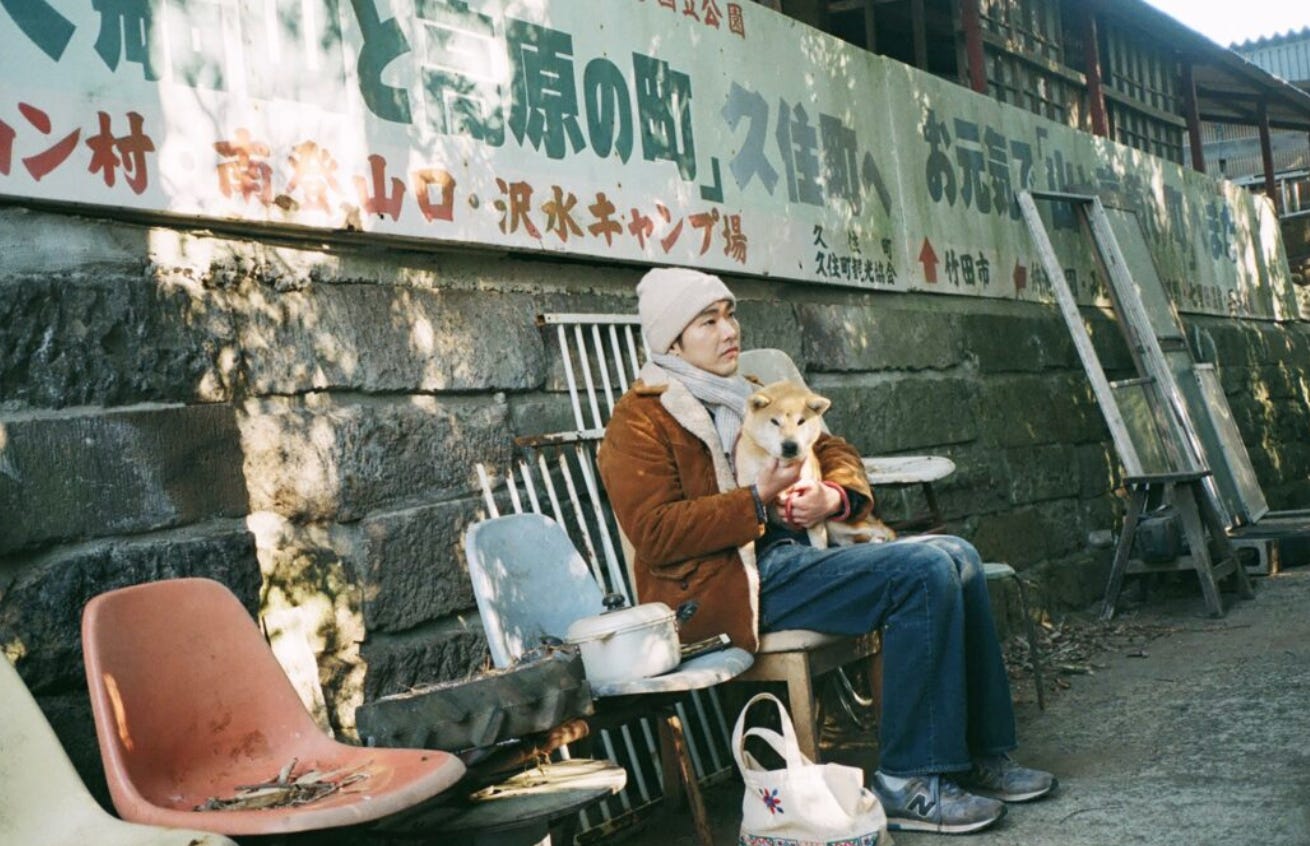

Here at the height of summer, when blockbusters (and would-be blockbusters) are hurtling through space like asteroids, I’m seeking stardust: something subtle, incidental, tangential. “Memorizu”—which premiered at Tribeca earlier this month—fits the bill, for anyone in the mood for a modest, haiku-like piece of film.
The theme wastes no time (and no words) announcing itself: the opening shot is a woman on a ferry, looking out a wide window to the sea. The window is a natural frame, and the scene is photogenic, causing the woman to snap a pic. The film asks: what does it mean when camera-rendered images constantly compete for our attention with real-time sights and sounds?
If “Memorizu” has a plot, it is this: a man named Yuta temporarily leaves his wife and young daughter to travel to a rural island to help his father-in-law, a photographer named Makoto, who broke his leg. Yuta walks Makoto’s dog around town and in the countryside. Each day he sees a horse between two trees in front of a mountain. And a woman bicycling down the road. The experience repeats, in a comforting way.
Old man Makoto has a portrait studio … he takes pics of school kids, brides and grooms, and friends and family. Yuta watches Makoto take some engagement photos and he flashes back to his own wedding. The world is full of more frames: rectangular doorways, arching mountain tunnels, picture windows. Memory, too, is a frame.
In this film, first-time director Miiku Sakanishi goes all in on the mise-en-scène, or placement of objects in the frame, in a very Japanese way. While watching the film, I could imagine him setting up a ladder to get the shot of a person in bed, or selecting a shot of shimmying leaves on a tree.
The characters in “Memorizu” are filmmakers (like all of us). Yuta mounts his phone on the car dashboard and sends images of his travels. His little daughter stars in little videos her mom sends to Yuta. In one shot, a character scrolls through his phone’s photo library. We’re all familiar with the sensation of our personal histories being reduced to this ever-accumulating, cloud-stored grid of squares. Do photos and images make memories, or displace them?
If you’re down for a bit of cinema that’s meta, meditative, and elliptical, “Memorizu” is a refreshing philosophical palate cleanser.