
Michael
A dazzling and profoundly entertaining portrait that makes us remember everything we loved about Michael Jackson (and forget about the icky later years).

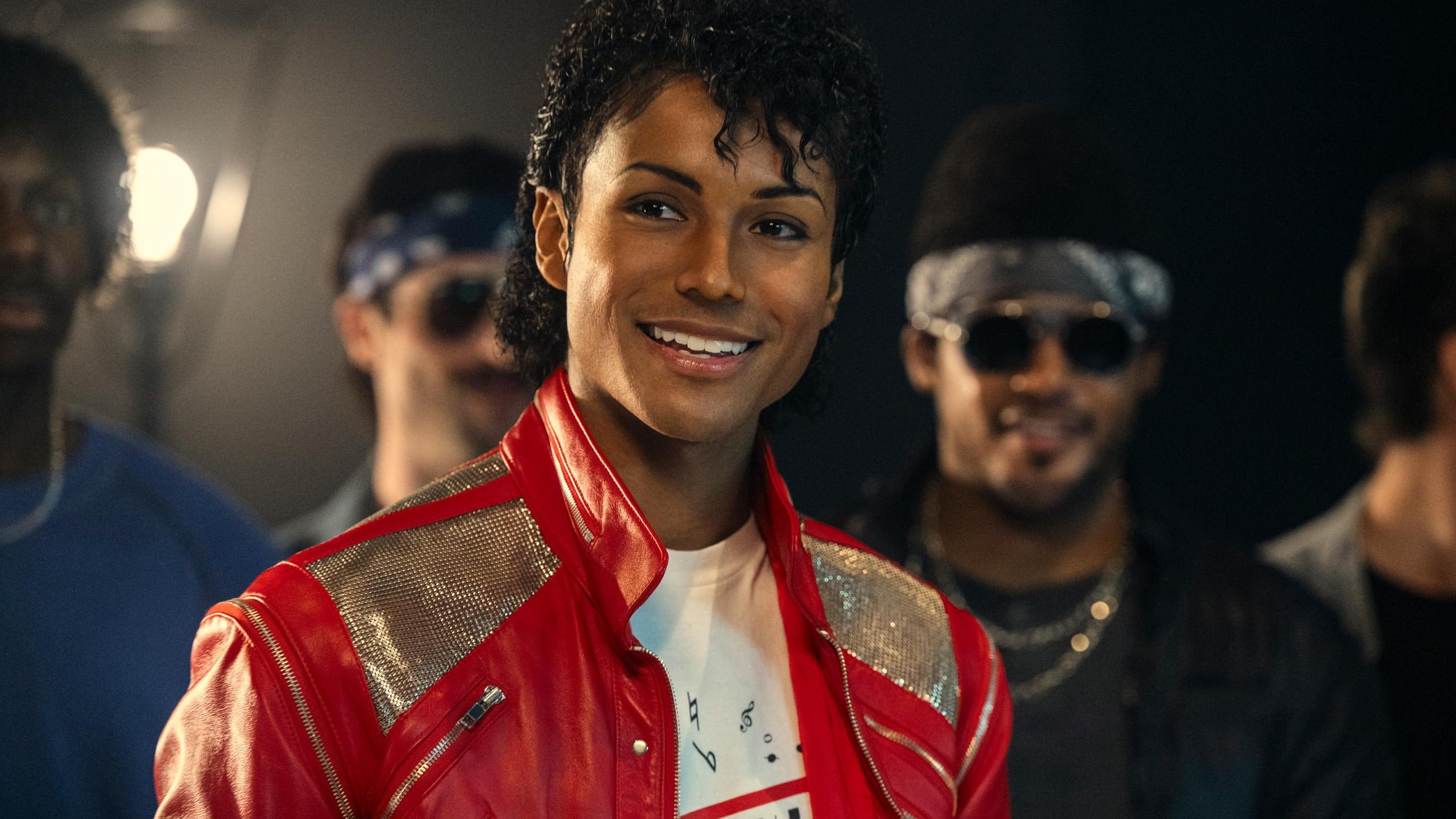

They’ve made a movie and it’s about this character named Michael Jackson. He’s a singer who grew up in Gary, Ind., performing from childhood alongside his four brothers, driven by their ambitious, abusive father. He went on to become the biggest star in the world, yet remaining the purest heart — a sweet, simple kid who believed in the power of music and dance to change the world.
I have been reliably informed that “Michael” is a controversial movie. That’s because it’s a sanctioned project by the Jackson family, and even stars Michael’s nephew Jaafar Jackson in the title role. While it’s certainly not shy about depicting the complicated, even hateful relationship with his father, Joseph, the film — directed by Antoine Fuqua (“Training Day”) from a script by John Logan (“Gladiator”) — ends in 1988, before the stranger and more disturbing aspects of the star’s later life became wedded to his persona.
So I went into this movie with, if not quite a frown, then with a grim set to my mien. Were we just going to get glossed-over hagiography? My skepticism was set to full dial.
And then… I couldn’t stop smiling. My feet couldn’t stay still. I was swiveling in my theater seat and quietly snapping my fingers. In the film’s harsher moments (and there are plenty), I rooted for Michael to overcome his father’s overbearing nature and find the freedom in his heart to match the gravity-defying joy he expressed on the stage.
It’s a dazzling and profoundly entertaining portrait that makes us remember everything we loved about Michael Jackson, while conveniently forgetting about the icky later years.
For some, I know they just won’t be able to make the jump. Jackson’s been gone 17 years and younger people likely remember him for the ghost-like figure whose unceasing plastic surgeries caused his nose to collapse, the obsession with exotic animals and ghastly artifacts, dangling a baby over a balcony, and of course the hotly debated (and never legally proven) allegations that he sexually abused children.
To Gen Z and Alpha kids, Michael Jackson must seem as remote and ridiculous as 1970s-era Elvis did to me.
The movie ran into delays, rewrites, reshoots, legal maneuvering and familial squabbles. (Janet Jackson is not even mentioned; blame the lawyers.) At one point it was going to be released with a running time of 3½ hours and included all the gossipy and disturbing material. Now the plan is reportedly to put out a second film that covers that somewhere down the road. We’ll see if that happens; I’m still skeptic enough to have my doubts.
So is “Michael” a sanitized version of Jackson’s young life? You’d have to say yes.
But the late, great Gene Siskel taught a critic’s duty is to review the movie they made, not the one he/she wishes they made. In following that worthy creed, I have to judge this a terrific picture. How accurate it is to the real man who moved through the world, I cannot say.
Let’s start with Jaafar, whose father is Jermaine, one of the original Jackson 5. He doesn’t particularly resemble his uncle facially, but with Hollywood makeup, hair, lighting and costume, the gap isn’t too far. He somehow even manages to dramatically change the shape of his nose after Michael gets his first of many plastic surgeries. Juliano Krue Valdi ably handles the kid portion when Michael was the frontman for what we’d now call a boy band.
Jaafar, as is a common technique for musical biopics, did his own singing that was digitally married to tapes of the real McCoy. And he nails the hip-twisting, lightning-footed dance moves that were Michael’s calling card. During the dozen or so musical sequences, it looks, sounds and feels just like Michael Jackson.
The movie slam-dunks the portrayal of his father, Joseph, with the casting of Colman Domingo, who has to be counted among the finest actors working in film today. During the early scenes in Gary, Joseph — that’s what the kids call him, not “Dad” — is a seething, malevolent presence, pushing the brothers to relentless practice at all hours of the day and night. He’s cagey enough to pick Michael out as his designated whipping boy, which in this case is a literal, not figurative description.
“In this life, you’re either a winner or a loser,” is Joseph’s mantra.
His mother, Katherine (Nia Long), suffers in mostly silence, trying to stand athwart her husband’s abuse but also not become a target. Later, we’ll quietly cheer as she begins to find her own, sterner voice. Long has some of the most touching moments with Jaafar, as mother and son who loved nothing more than curling up on the couch to watch old movies, with a special preference for slapstick comedies and classic horror.
The brothers and sister La Toya Jackson operate here mostly as Greek chorus, present but not really important other than as background figures who duck and slump away from Joseph’s iron control. The siblings do not seem especially close and his older brothers often tease him. It’s hard to believe, but despite the increasingly tense family situation as Michael launched a solo career, he continued to live with his parents until almost age 30.
The deepest vein of the movie’s theme is Michael’s fear of his father, and gradually growing up enough to finally go his own way as a musical artist. Initially he has no stomach to stand up to Joseph, even dispatching the record label guys to inform the old man about plans for his debut solo album in 1978.
As time goes by, Joseph becomes less of a menacing figure, even rather silly in his Jheri curls and disco peacock outfits. But if the rheumy-eyed lion has lost his bite, he can still scratch and roar plenty enough to tear at Michael’s spirit.
Some standout supporting performances bolster the framework. Larenz Tate plays Motown king Berry Gordy, the first big name to recognize Michael’s specialness that went beyond his talent. Quincy Jones (Kendrick Sampson) picks up this mantle as a stand-in father figure later on. Miles Teller is John Branca, a lawyer with music in his heart and an abiding belief in his client. Bill Bray (KeiLyn Durrel Jones) is a soulful presence as Michael’s bodyguard who becomes his brother/protector, squiring him around in a very unimpressive 1977 Mercury Monarch.
And Mike Myers has a killer cameo as CBS Records honcho Walter Yetnikoff, who in another can-you-believe-it moment had to twist the arms of MTV to play the video of “Billie Jean” because in 1983 they were reluctant to program Black artists.
The movie does not depict any sort of romantic interests for Michael, and indeed he comes across as almost sexless. There are plenty of peeks into what makes him tick, and what we see is a very straightforward, simple man: he loves his family, creating music, dancing, animals (he calls them “friends” not pets), toys and games, making people happy — and behind that soft, angelic voice, he harbors a crusader’s zeal to become the biggest name in entertainment.
“Michael” is an electric portrayal of a guy who lived a life with as polarized extremes of charm and curse as can be known. I don’t know if it’s true — but after reveling in this extraordinary cinematic experience, I truly wish it is.
idk... if Jeffrey Epstein had sang Beat It I probably still wouldn't want to go see his biopic.