
My Neighbor Adolf
A little gem of a movie about a Holocaust survivor who suspects his new neighbor is the Führer; it starts out as a comedy caper, edges into tragic lament and somehow lands in sweet sentiment.

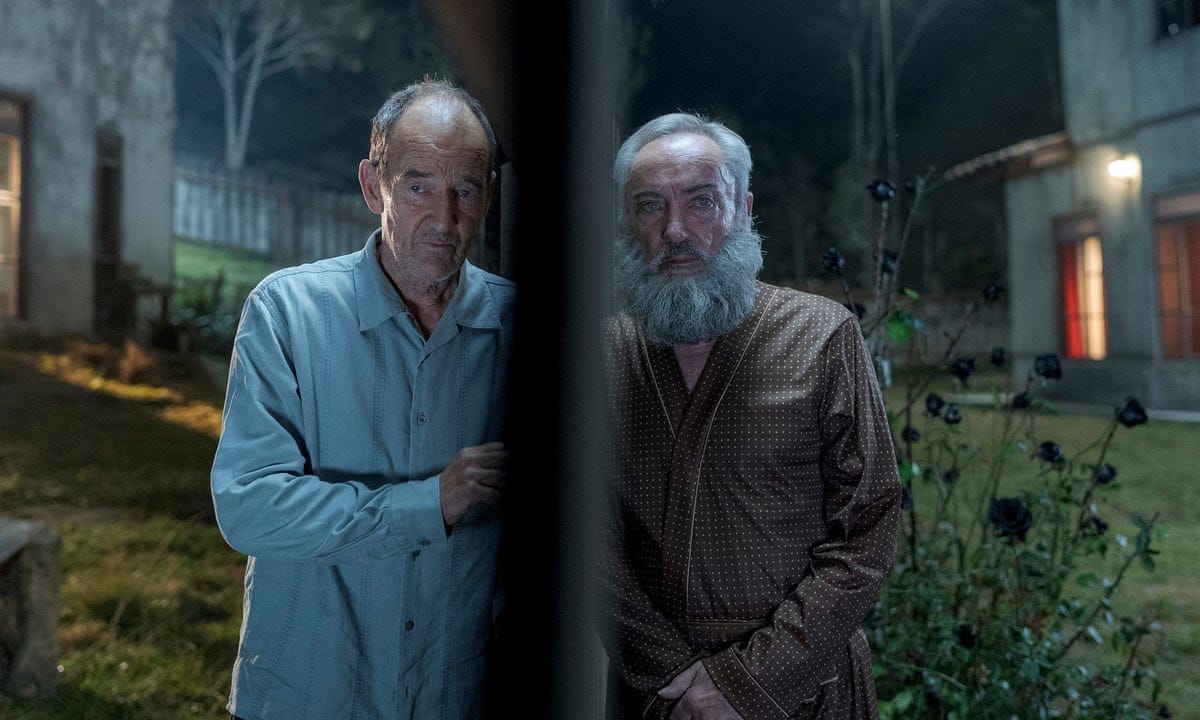

Since Adolf Hitler’s reputation is somehow on the rise in some sordid circles, now might not seem like the best time for a scampy comedy about a Holocaust survivor who suspects his new neighbor is secretly Der Führer.
Oddly and refreshingly, “My Neighbor Adolf” turns out to be little gem of a movie that starts out as a humorous caper, edges into tragic lament and somehow lands in sweet sentiment.
Directed by Leon Prudovsky from a screenplay he co-wrote with Dmitry Malinsky, this movie took me to places I didn’t really want to go, but when we got there I felt like I didn’t want to be anywhere else. It’s funny and sad, and also a great humanist parable.
Set in 1960 South America, it stars David Hayman as Marek Polsky, a Polish Jew who lost his entire family in the Third Reich’s Final Solution. Consumed with bitterness, he lives a simple life in a run-down cottage in the middle of nowhere, and his only passion seems to be tending to a prize bush of black roses.
He learned this art from his mother, as seen in a flashback prelude, even inheriting her trick of mashing up eggshells in water to make a hearty tea fertilizer.
The rest of the property is a shambles, just a step north of derelict. For some reason there is a similar condition house immediately next door, with which Polsky shares a fence. Why anyone would build two houses right next to each other in such deep isolation is left a mystery, though certainly it suits Polsky as the other domicile has long been vacant.
That changes when an officious German woman, Kaltenbrunner (Olivia Silhavy), shows up one day inquiring about the property. Both houses have large wooden doors entering the property with buzzers and medieval-style sliding spy holes, which seems a pretty ambitious expectation for unlikely visitors. Polsky conducts all his business through this porthole, usually just the newspaper boy or mail, and we get the sense he rarely leaves the place at all.
Things change seemingly overnight as Kaltenbrunner brings in a busy crew to fix up the place and move in her client, a shadowy older man with a long gray beard and omnipresent sunglasses, even at night. They are all German, and the neighbor — whose name is Herzog — even keeps a German Shepherd.
Needless to say, this brings back terrifying flashbacks for Polsky, made even worse when the dog, Wolfie, breaks through the dilapidated fence and snaps some of his precious roses. His first interactions with Herzog are accusatory and unpleasant.
Things grow worse when he insists on the fence being fixed, and Herzog’s lady majordomo determines the rose bush actually resides on their side of the property line. So they build a whole new fence, cutting Polsky off from the one thing of beauty in his life.
Clues begin to mount that Herzog is actually Hitler, somehow survived from his supposed suicide in 1945. There’s a great physical resemblance, and also the regular German visitors who come in the dead of night. Herzog is an amateur painter, and left-handed, and so on. Polsky even buys books about Hitler’s early career as an artist to compare with his new works.
It’s right about this time in a movie when the audience would say, “Why doesn’t he just report it?” And to the filmmakers’ credit, that’s exactly what Polsky does, marching into the Israeli embassy in the city and demanding an investigation. This was a time when South America was supposedly rife with hidden Nazis, and the weary intelligence officer (Kineret Peled) dismisses Polsky, saying they get these kinds of Hitler reports by the score.
This is the fun portion of the movie, but things grow more somber as Polsky attempts to engage directly with Herzog in an attempt to gather evidence, such as getting a sample of his handwriting. They share a love of chess, they share a few drinks and the coldness between them begins to thaw.
Herzog is played by Udo Kier, a German character actor who has one of the most recognizable faces in cinema, even if you don’t know the name. It was an interesting choice to cast a thespian with an iconic villainous look as the supposed Hitler, but he plays Herzog with a mix of anger and vulnerability we don’t expect.
Herzog sees the number tattooed on Polsky’s arm, asks after his family, and something like a comradeship begins to grow between them — even as Polsky wonders who this strange man truly is.
I appreciated the film’s ability to balance different tones, often at close juxtaposition. You’d have to call it a black comedy given the thematic undercurrent, but there are weighty notes that bely Polsky’s little Nancy Drew investigation. Both of these two old men are carrying a heavy burden of some sort with them, unable to live in the present because of the traumas in the past.
Both Hayman and Kier give tidy performances, very specific and centered. There’s no winking to the audience here, and we feel guided along by them through the film’s strange tides of mirth and malevolence.
There have been other movies that have attempted to explore or even humanize Hitler, such as 2002’s “Max” (about his young life as a painter) and 2004’s “Downfall” chronicling his end. “My Neighbor Adolf” isn’t really in the same category, as it’s more about Polsky coming to terms with the dictator’s monstrous legacy, and if he can ever appear out of that shadow.
It’s a strange morsel of a movie, and one I didn’t expect to savor as much as I did.