
Nouvelle Vague
Richard Linklater's ode to the French New Wave is a movie deliriously in love with movies -- at least, the ultra-pretentious, self-serious sort that insists upon being called "cinema."



Nobody does pretentious better than the French. Except maybe American filmmakers mimicking them.
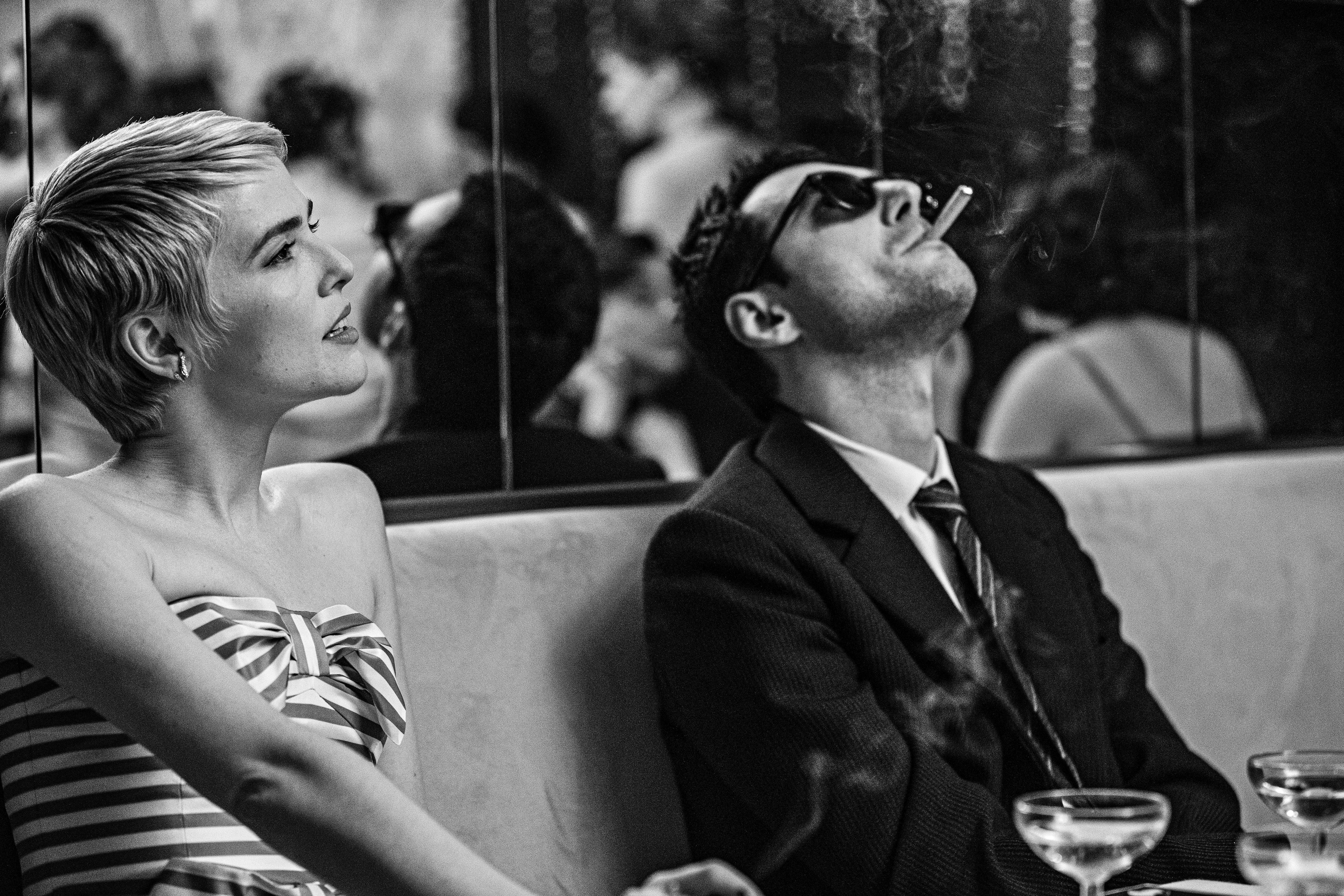
“Nouvelle Vague” is Richard Linklater’s ode to the French New Wave of the late 1950s and early ‘60s, in particular the making of Jean-Luc Godard’s first film, “Breathless.” It’s a movie deliriously in love with movies — at least, the ultra-pompous, self-serious sort that insists upon being referred to as “cinema.”
The New Wave is perhaps the most lavished movement in film history, a period in which entire legions of new directors debuted their work that was both inspired by and a break from traditional aesthetics. It was raw, deliberately amateurish, youth-driven and puckish — deeply influenced by American movies and in turn influencing the Boomer generation of our filmmakers.
(They also copped a lot more from the Italian Neorealists than anyone cares to admit.)
The movement actually had its birth in film criticism. Many of the key figures wrote for Cahiers du Cinéma magazine, and spent years formulating an approach to moviemaking based on the theory of auteurism, which posited the director as the primary author of a film.
They later admitted it was pretty much all a front to draw attention to themselves so somebody would let them make their own movies. Eventually, they did.
I’ll admit my bias that I’m not terribly enamored with the New Wavers. Firstly, by treating the craft of criticism as merely a stepping stone to making art of their own. Some figures I’ve appreciated — Francois Truffaut in particular — while others not so much — Godard in particular. To indulge in my own conceit and quote from my essay on “Breathless:” “Truffaut told stories, while Godard was a master of mood and moments.”
Linklater’s approach is a mix of hagiography for the New Wave and aping its style. “Vague” positively worships Godard and the other movement principles, featuring them in background roles highlighted by lingering portraits with title cards to let us know who they are. Truffaut, Claude Chabrol and Suzanne Schiffman are chief among them, but there are dozens so honored.
He shoots in black-and-white with a style meant to mimic that of “Breathless,” even going so far as to introduce fake scratches in the image and splicing cue marks for projectionists, as if the movie were clattering through an old flickering light projector rather than rendered digitally, like most everything else these days.
(It will have a limited theatrical run starting Halloween then stream on Netflix Nov. 14.)
Godard is played by Guillaume Marbeck as a man so convinced of his own visionary potential that he can will it into existence. Never seen without his signature dark sunglasses — even while watching movies in a theater — he’s charming, rude, egotistical and supremely confident. He insists he and his peers are creating an entirely new cinema (don’t call them ‘movies’) based on improvisation, natural lighting and guerilla-style filmmaking with hand-held cameras.
“The best way to criticize a film is to make one,” he brags.
Given a tiny budget and just 20 days to shoot by producer and New Wave ally Georges de Beauregard (Bruno Dreyfürst), Godard immediately sets about alienating seemingly everyone on his tiny crew. The first day, they only shoot for two hours before wrapping. Other days, they don’t shoot at all.
He never even bothers with actually writing a script, simply coming up with an outline based on a real-life car thief. ‘A girl and a gun is all you need for a movie,’ he insists. Each morning the actors and crew linger in a cafe while Godard scribbles notes to himself in a little black book, everyone waiting for the self-appointed genius to receive and share inspiration.
Zoey Deutch plays Jean Seberg, an American film star lured into this tiny French picture by her husband, François Moreuil, a pal of Godard’s. At first intrigued by the idea of a new aesthetic, she’s soon put off by the director’s seeming indifference to the process of filmmaking — or even giving the barest respect to his actors.
He won’t even allow them to learn their lines beforehand, literally shouting the dialogue to them from behind the camera because he doesn’t want them to sound practiced.
She wants to quit, but is talked into staying by her husband and co-star Jean-Paul Belmondo (Aubry Dullin), who has known Godard for years and is more in vibe with his “whatever happens” approach to shooting movies. Of course, as a virtual unknown at the time, he has much less to lose — something Linklater reflects by pushing the Belmondo character deep into the background to the point of vanishing.
I found interesting the relationship between Godard and his cameraman, Raoul Coutard (Matthieu Penchinat), selected for his experience shooting war footage with a tiny camera. They improvise the look of “Breathless” as they go, cutting holes in carts allowing Raoul to hide inside with his camera so as not to distract passerby (free extras!) or using a wheelchair as an improvised dolly.
As things go on, most of those involved become convinced the project is a complete disaster that will ruin their careers, or more likely go into a vault and never be scene. Godard is steadfast in his commitment to his approach, never seeming to sweat or second-guess — even when the producer threatens, not for the first or last time, to shut production down.
“Audiences will accept our new truth,” Godard purrs.
He was, of course, right. “Breathless” became a huge sensation, one of the most influential films of its era, and Belmondo and to a lesser extent Seberg became overnight international stars. And, of course, Americans like Linklater (born the same year the movie came out) became aficionados, now supplicants to the New Wave mythology.
I realize my disdain for Godard and the deification of the New Wave has probably made it sound like I loathed “Nouvelle Vague.” I didn’t. I even enjoyed and appreciated it on some level. It’s a gorgeous-looking film, thought obviously quite painstakingly planned and executed to look that way, as opposed to the cinema verite of “Breathless.” The irony is delicious.
As much as Linklater is revering the New Wave, his own movie acts in some ways to demystify and interrogate the process of how it came to be. It both starts and begin with the foursome of New Wavers sitting in the dark, watching a movie, then turning to each other with delight once the lights come back in so they can share their giddy appreciation or snide repudiation. Linklater clearly wishes he could have joined that circle.
Does this cinematic effort feel on some level unnecessary or unworthy? To my eyes, it does. But maybe others who are ensorceled by the French New Wave or Godard will greet it more enthusiastically than this critic.
For my part, I can assure you I’ve never held any interest in making movies — certainly not abusing my humble forums as a lever to do so. Watching movies is ever so much more fun than making them, even in the overly idealized way depicted in “Nouvelle Vague.”
"(They also copped a lot more from the Italian Neorealists than anyone cares to admit.)" There is a scene in the film in which Roberto Rossellini visits the Cahiers du Cinema offices, and is intro'd as the father of the New Wave by, I think, Godard in that scene. So it's not exactly some secret. Maybe it's not common knowledge or more openly talked about in circles but it's not taboo or an embarrassement to point it out.