
Omaha
A father takes his kids on an impromptu cross-country road trip, in an observant, contemplative tome poem of a movie that uses its spareness as a strength.

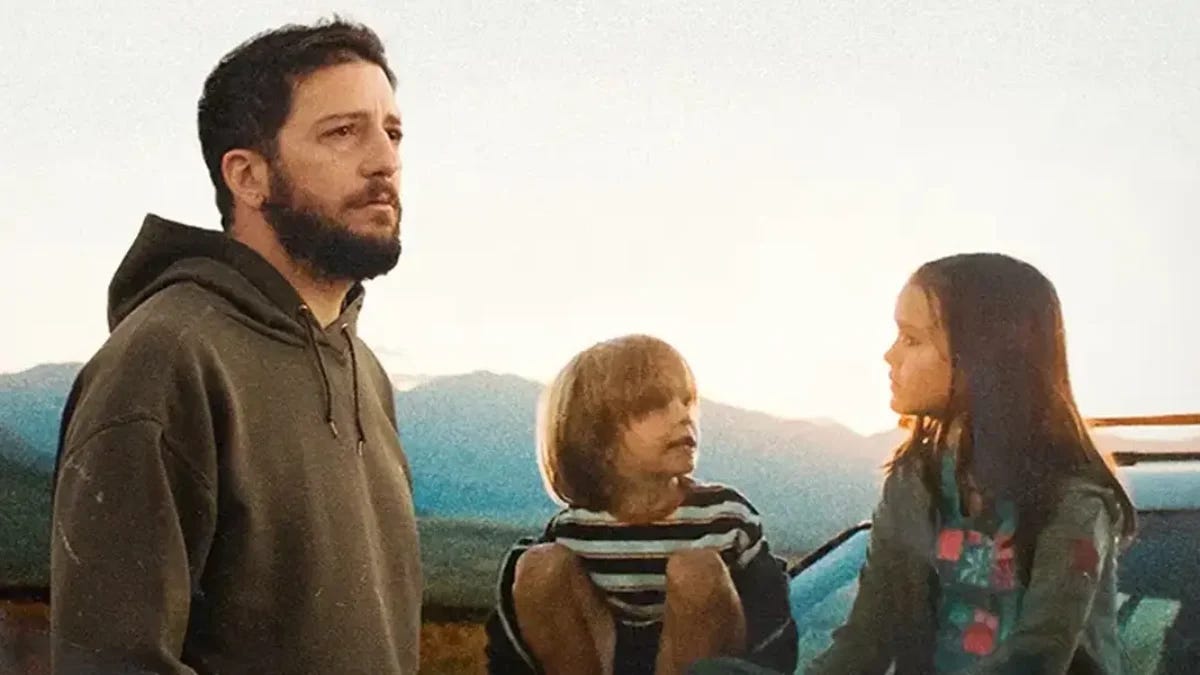

The best description I can come up with for “Omaha” is that it’s minimalist filmmaking. It’s a very spare tome poem of a movie, undoubtedly shot on a shoestring budget, and barely cracking 83 minutes in running time.
But I nonetheless found it to be a satisfying cinematic meal. What it lacks in bounty it makes up for in its quiet, observant humanism.
The story is very easy to summarize: a father wakes his young children out of bed one morning, plops them into their ancient car and announces they’re taking a trip. The kids initially enjoy this spontaneous adventure, but gradually become more anxious about where they’re going, and why. Nebraska, is all their dad will say.
Ella, age 9, is played by Molly Belle Wright with amazingly accessible emotions and a steady screen presence. She acts as the main viewpoint character, watching her father with a respectful admiration, even when she knows he’s not being his best self. We feel the hope she holds for him almost as a palpable presence.
In many ways “Omaha” feels like an autobiographical journey told by Ella, though it’s an original screenplay by Robert Machoian. A few years ago he wrote and directed “The Killing of Two Lovers,” another understated beauty that takes place largely in the geography of the Americans Plains, and with similar themes about a fractured family trying to find its way.
Her father is played by John Magaro, a compelling character actor you may recall in supporting parts and the occasional lead in pictures like “First Cow,” “The Big Short” and “Past Lives.” We don’t even hear the character’s name (Martin Harper) until the very last scene, and it’s probably for the best that the audience simply regards him as Dad.
It is his identity, and his quest.
Dad is clearly going through some tough times. His wife died, not recently but not so long ago that the pain isn’t still present and sharp. If he has a career, we don’t hear about it. I expect he’s one of those hard-working but unskilled guys who tends to drift from job to job, with lulls in between.
It’s clear that leaving their house is not his idea. They abandon most of their stuff, only taking some clothes and their few prized possessions — Ella’s are books — along with the family dog, Rex. The rest they leave behind, and it’s clear from the arrival of a deputy sheriff shortly before their departure that Dad doesn’t intend to return.
The youngest child is 6-year-old Charlie (Wyatt Solis), one of those quietly happy kids who lacks focus, his attention butterflying from one thing to the next. He and Ella get along just fine, and Dad is the hands-off type who lets his children have just enough free rein to build responsibility without getting into too much trouble.
(Though Charlie has minor klepto tendencies, snatching small toys and candy at their stops.)
Their 1990-ish Toyota Corolla All-Trac Wagon has seen better days. It’s currently got a bum battery, so Dad and Ella have to do the old push-start trick to get it going each day. It also becomes increasingly clear that Dad’s financial resources are limited to the dwindling cash in his wallet and what’s left on their EBT card.
Does he have a job lined up at their destination? Family to crash with? Any sort of prospects at all? As their destination grows nearer, the tension we experience about the purpose of this journey ratchets up, click by click.
The photography by Paul Meyers has a washed-out sort of charm, not idealizing these American spaces but registering them through the bleak prism of the family trip. The music by Christopher Bear is unobtrusive to the point of not registering on our consciousness, but plucks the mood of the piece with subtle strokes.
The film is directed by Cole Webley, his first feature film after a lengthy apprenticeship in shorts and commercials. Like the movie, it’s not the sort of work that draws attention to itself or is out to force an impression. I appreciated the contemplative approach to filmmaking, not concerned so much with what happens but how what is happening dwells upon the characters experiencing it.
“Omaha” is as much about a feeling as a place or time. As this family undertakes its transit, we understand that there is no return leg for this journey. Even as the open road stretches out before them with endless possibility, their story is about facing some kind of end.