
Power Ballad
John Carney is back in familiar form with his latest flick, "Power Ballad," an irresistibly charming music dramedy.


John Carney is like a musician, and not just because all of his films are about musicians. Between “Once,” “Begin Again,” “Sing Street,” “Flora and Son,” and now “Power Ballad,” Carney’s movies follow a similar rhythm. That’s not a bad thing, especially since Carney’s movies are earnest and cozy.
Even if you haven’t seen any of his films, you will surely know a song or two from his movies, in particular, “Falling Slowly” from “Once.” Carney has struck musical magic once more with “Power Ballad,” which features a spectacular single that sets the stage for the clash between Paul Rudd and Nick Jonas.
Rick Power (Rudd) was once a promising young musician with dreams of his band, Octagon, headlining Madison Square Garden. While performing in Dublin, he met Rachel (Marcella Plunkett) and fell in love. The two ended up getting married and having a child, Aja (Beth Fallon), with Rick leaving the US and the rock star life behind.
Years later, Rick now works as the lead singer for a wedding band, The Bride and Groove, performing yacht rock and disco hits to drunken wedding parties. He still tries to throw in a few of his original tracks into his performances, often leaving the guests confused.
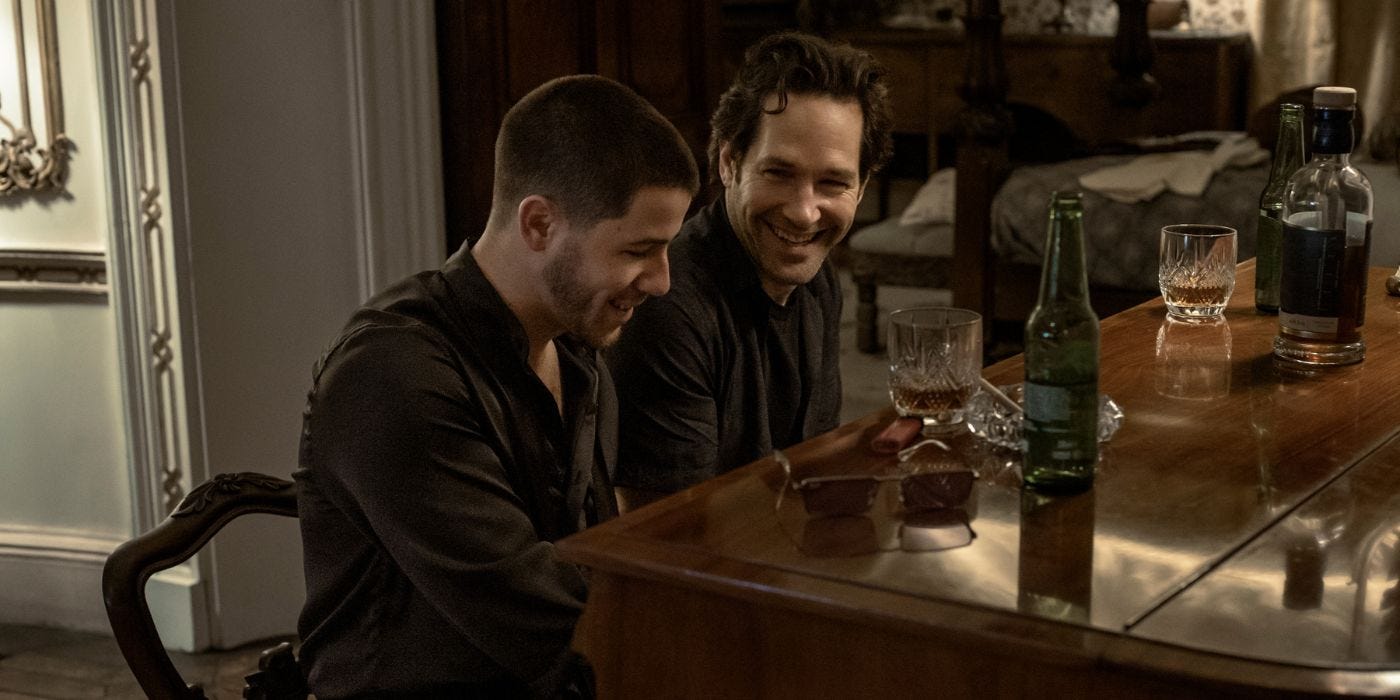
While performing at an elaborate estate, Rick is introduced to former boy-band singer Danny Wilson (Jonas). Initially, the two hit it off extremely well, and after a night of boozing and getting high, Rick plays Danny a song he wrote for Aja when she was still a baby.
Six months pass, and Rick is shocked when he hears his song playing on the radio, sung by Danny. Even worse for him, the song is a massive hit, and Danny has taken all the credit. Rick tries to convince his friends and family that he was the true writer of the song, but nobody seems to believe him. Back in the US, Danny initially considers giving Rick some sort of residual, but is coaxed out of it by his arrogant producer, Mac (Jack Reynor). Knowing he’s missed his unexpected second chance at success, Rick’s life begins to derail.
“Power Ballad” treads familiar territory for Carney, one of music and dreaming of the stage. Yet, it is just as heartfelt and endearing as the rest of his filmography. You are also able to buy into the story as the titular power ballad titled “How to Write a Song (Without You)” is the kind of song that would top the music charts. Most importantly, it gives the movie a soul. Something every Carney movie requires.
Similar to Carney, Rudd is an artist with a successful knack for playing a certain type of character. If it’s working, why stop? Unless one counts his memorable cameo as John Lennon in “Walk Hard: The Dewey Cox Story,” Rudd has never actually played a musician. Likely because he doesn’t particularly strike you as the kind of actor who can actually sing. Possibly the biggest surprise of “Power Ballad” is that not only does Rudd sing a lot, but he’s incredibly good at it. He’s also excellent off-stage as well, playing a character that is instantly likable and sympathetic, even if he’s not always making the right choices.
Jonas also delivers a great performance, cleverly playing into his background as a Jonas Brother. It’s definitely not the most difficult role for him to pull off, but he does get to play with the arrogant celebrity persona. Reynor, who has become a staple for Carney, also gives a memorable supporting performance. Peter McDonald is a major scene-stealer as Rick’s bandmate, Sandy, who gets some of the film’s biggest laughs in its third act.
Carney is playing it relatively safe for the first two acts of “Power Ballad,” before pivoting into a third act that is even more grounded than we tend to expect from him. The movie intentionally chooses not to tie every loose thread up in a neat little bow, instead opting to leave a sprinkle of ambiguity into the conclusion.
“Power Ballad” may not be the most ambitious flick you’ll see this summer, but that doesn’t mean it proves that Carney is interested in switching things up over time. His movies will likely always prominently feature music and a cozy, soulful voice you can’t ignore. But it also signals that Carney is willing to let the characters in his stories be messier.