
Pressure
A story of wind and warring personalities, this World War II saga is another peek behind the amazing true story of the most pivotal event in human history.


I honestly never get tired of World War II movies.
It was the most pivotal event in human history, and likely (hopefully) will remain so forever. Beyond the untold millions who died, it shifted the very face of the planet into the configuration we see today. And there are stories, so many stories, that we still have to hear.
“Pressure” is such a tale, and a grand one. It’s a story of wind — of weather, and warring personalities and the decision for the most important day of the war: June 6, 1944, aka D-Day, when the Allies landed on Normandy and began the long, hard but inevitable march to overthrow Hitler’s evil regime.
Or June 5, as it was originally intended to be. The attack was all lined up for that Monday, with hundreds of thousands of troops arrayed and tens of thousands of ships, planes and armored vehicles. Did you know that 8,000 doctors were part of the assault? I did not. The Allies had spent months building up decoy units, misleading counterintelligence, and so many other efforts to divert the Nazis, some of which even became their own movies.
And it all would have failed. Without meteorology.
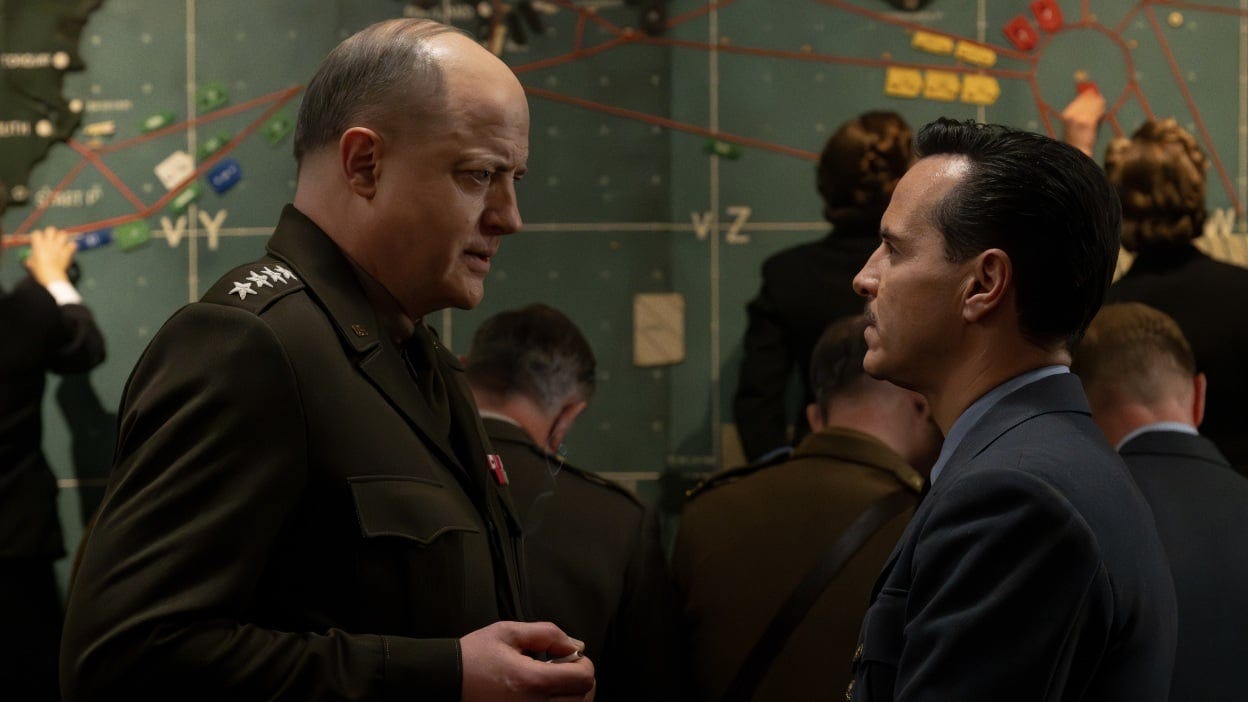
If you’ve seen the trailers or hype for “Pressure,” you probably think it’s a Brendan Fraser star vehicle. He plays Gen. Dwight D. Eisenhower, aka “Ike,” the supreme commander of the Allies, and it was his call when and where D-Day would happen.
Fraser, who resurrected a dormant career with his Oscar-winning performance in “The Whale,” doesn’t much resemble Ike, a famously pencil-necked man, instead looming like a bear stuffed into a military uniform. Nonetheless he’s terrific, putting out a deliberately intimidating presence to his command that threatens to collapse into anxiety and self-doubt behind closed doors.
Part of that is due to Exercise Tiger, the little-known tale of a training exercise Ike ordered as a practice run for D-Day that resulted in hundreds of friendly fire deaths.
But Ike is not the central character. That’s Group Captain James Stagg, a nebbishy, tightly-wound meteorologist who was more or less foisted upon Eisenhower by Winston Churchill, who declared him a genius at predicting the very unpredictable weather in the English Channel.
Ike wanted to go with his own guy, a confident American with an unbesmirched record of success during earlier campaigns in North Africa. And he’s got his own braying hounds in the form of the other Allied generals insisting the attack has to happen on June 5, or the war is lost.
So the title — based on a play of the same name by David Haig — alludes to not just weather systems, but also the crushing weight of command placed upon Ike, which then spills onto the narrow shoulders of this unheralded Scotsman.
Played by Andrew Scott, Stagg is not an easy guy to like. He’s insular, snobbish, condescending. When he arrives at the meteorology office at Southwick House where the invasion leadership is set up, it’s like a dark cloud descending upon a sunlit picnic. Once loose and happy, the scientists become nervous and defensive. They’re forced to work all hours of the night, without encouragement or thanks.
And Stagg has the unfortunate tendency to tell them they’re all wrong, and he’s the only right one, and everybody else is blind and stupid. Not in so many words — well, not until the pressure really gets intolerable. On top of everything else, Stagg’s wife is about to give birth, and he’s cut off by the communications blackout in force for the entire operation.
His chief antagonist is Ike’s meteorologist, Col. Irving Krick (Chris Messina), who’s just as easygoing and charismatic as Stagg is off-putting and unlikable. Their head-butting eventually reaches the point where Stagg prevents Krick from attending the weather briefing for the other high brass so as not to cloud the recommendation.
Krick prefers to rely on historical weather data, pointing out that the brewing storm system in the Atlantic has been mirrored several times in the past, and always resolves before striking the French coast. Stagg discounts this approach, insisting on gathering a maniacal amount of weather measurements to produce a crystal ball that seemingly only he can interpret. And it says the weather will be disastrous on June 5.
“Get the data. That’s what counts,” he growls.
Acting as go-between for Ike and Stagg is Kay Summersby (Kerry Condon), Eisenhower’s Irish personal aide. She acts as a sisterly confidante, offering encouragement but also providing a swift kick in the rear when either man crawls too deeply inside his own head. She’s the first to recognize the fate of the war has fallen onto Stagg, and if Ike employs his usual overbearing ways the man will just crumple.
“Pressure” is written and directed by Anthony Maras (“Hotel Mumbai”), who served as executive producer and also is credited as editor — not something you often see on a bigger, complicated picture like this. The pacing is very tight, jumping straight from one tense moment to another, with just enough respite in between to give the audience a chance to breathe.
At a lean 100 minutes, it’s the rare war picture that feels quite big but doesn’t sprawl.
The supporting cast is top-rate. Damian Lewis plays Montgomery, the snippy British general who is resentful of Eisenhower being selected as the top dog and takes every opportunity to remind the room of his more extensive combat experience. Con O’Neill is Trafford Leigh-Mallory, head of the allied air support, who warns the attack can’t happen without good visibility. Robert Portal plays Bertram Ramsay, the naval counterpart who knows a sea landing is a no-go with waves above six feet. Jojo Macari is the young meteorology officer who gradually switches allegiances from Krick to Stagg.
Interestingly enough, Stagg is not a figure who has been completely forgotten in other screen accounts of D-Day. He was a minor character in “The Longest Day,” 2017’s “Churchill” and a 2004 TV movie.
Ultimately, “Pressure” is the story of two very different men who had little reason to trust each other. But they did, and it’s painfully easy to imagine how very different our history would be if they hadn’t taken that leap of faith.