
Shoshana
A harrowing and illuminating look at the violent emergence of Israel under British rule, though the romance suffers in comparison to the political thriller portion.

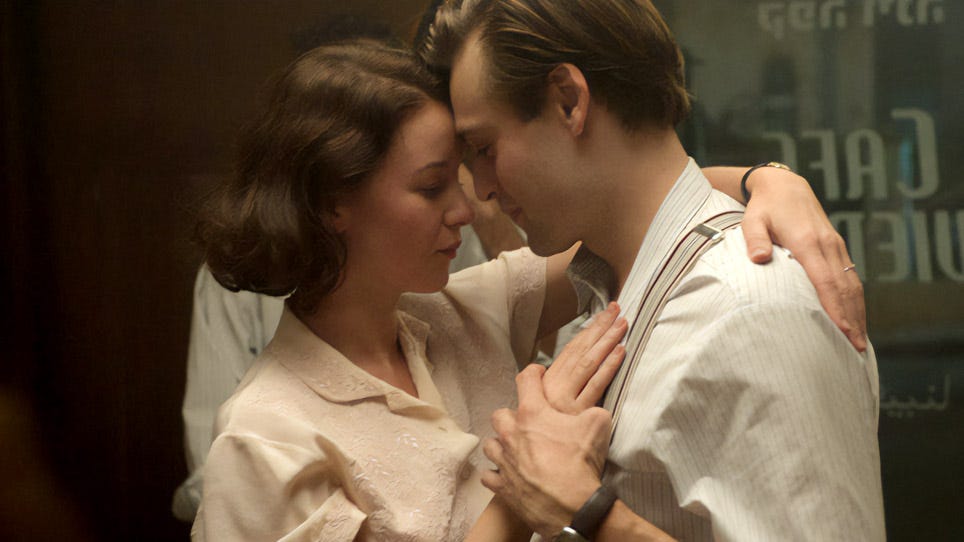

“Shoshana” is one of those rarer films where the central person in the story is not really the “main” character.
Shoshana Borochov was a Russian-born Jew who was active as a journalist, activist and soldier before and after the formation of Israel. The movie, a pet project of filmmaker Michael Winterbottom, is a harrowing and illuminating look at that violent time in the late 1930s to early ‘40s as the British rulers struggled to tamp down terrorist activity by both Palestinians and Israelis, both of whom came to resent and oppose the Western colonialists.
Shoshana, as played by Irina Starshenbaum, is headstrong and smart, trying to navigate a path between her Zionist peers and a British detective with whom she has fallen in love. Though an empathetic and powerful presence, the story is not really hers. More, she serves as the locus around which larger and terrible events swirl.
I found the political thriller aspect of the film extremely engaging. It shines a light on a pivotal but largely forgotten portion of Middle East history, a time when people vied for control of a dusty piece of land with competing claims. Each side, and their English overlords, were quick to employ the most dastardly means, including torture and the killing of innocents.
Of course, it’s hard not to see the parallels with the modern state of the area, which in some ways seems pitifully unchanged.
The romance between Shoshana and Detective Constable Tom Wilkin (Douglas Booth), though, suffers in comparison. It’s more of the backdrop to a crime procedural narrative, as Wilkin and his more aggressive colleague, Geoffrey Morton (Harry Melling), turn their investigation from the Palestinians setting off bombs to the Jews doing much the same thing.
As a member of the moderate Haganah faction that sought collaboration with the British, Shoshana still sympathized with some of the more extreme elements — some of whom Wilkin is commanded to hunt down. This includes Avraham Stern (Aury Alby), who wrote hateful screeds advocating for the assassination of British leaders and directed terrorist bombings.
So on the front stage of the screenplay — by Winterbottom, Laurence Coriat and Paul Viragh — you have Wilkin and Morton hunting Stern and his ilk, and in the background Shoshana and Wilkin trying to carry on something like a normal relationship. (The film only alludes, but they were actually married for a decade.)
Of course, this is impossible given the British standing athwart the Palestinians and Jews bent on killing each other. Shoshana is threatened by her own kind, and Wilkin finds himself passed over for promotion and investigated by his.
The violence in the film can be hard to watch. Winterbottom offers an unflinching look at the real devastation wrought on human bodies and souls by hidden bombs and bullets to the back. The worst elements of both sides truly thought of themselves as soldiers and women and children as their legitimate enemies to be targeted.
As a Brit who has lived in Tel Aviv for years and speaks fluent Hebrew, Wilkin thinks of himself as floating between these various constituencies, trying to do the good work of keeping the peace. In fact, he finds himself distrusted by virtually everyone. It’s possible his affection for Shoshana is merely an extension of his wayward sense of altruism.
She is protected somewhat by her status as the daughter of Ber Berochov, the intellectual leader of socialist Zionism. Like Wilkin, she is somewhat self-deluded by the extent her armor will save her from murderers hellbent on killing anyone in their way.
“Shoshana” is an odd film, one that I don’t feel always has a tight grasp on what it’s trying to accomplish. Is it a romance? A historical drama? A police procedural? A bit of all, methinks. But it’s a compelling and worthy picture.
It’s a movie about many things, not just one person, and powerfully presents a portrait of a time and place largely forgotten, but crucial to the here and now. Shoshana herself may have not been all that remarkable on her own, but she stood at the juncture of pivotal history.
Ezra editor
Mr. Eisner
Abraham Stern leader
Jabotinsky
LEHI freedom fighters of israel
Haganah moderates