
Sirāt
This Oscar-nominated trek through the desert is an oddly affecting exploration of people who are lost -- some by choice, while others quest to reunite with those who may not want to be found.

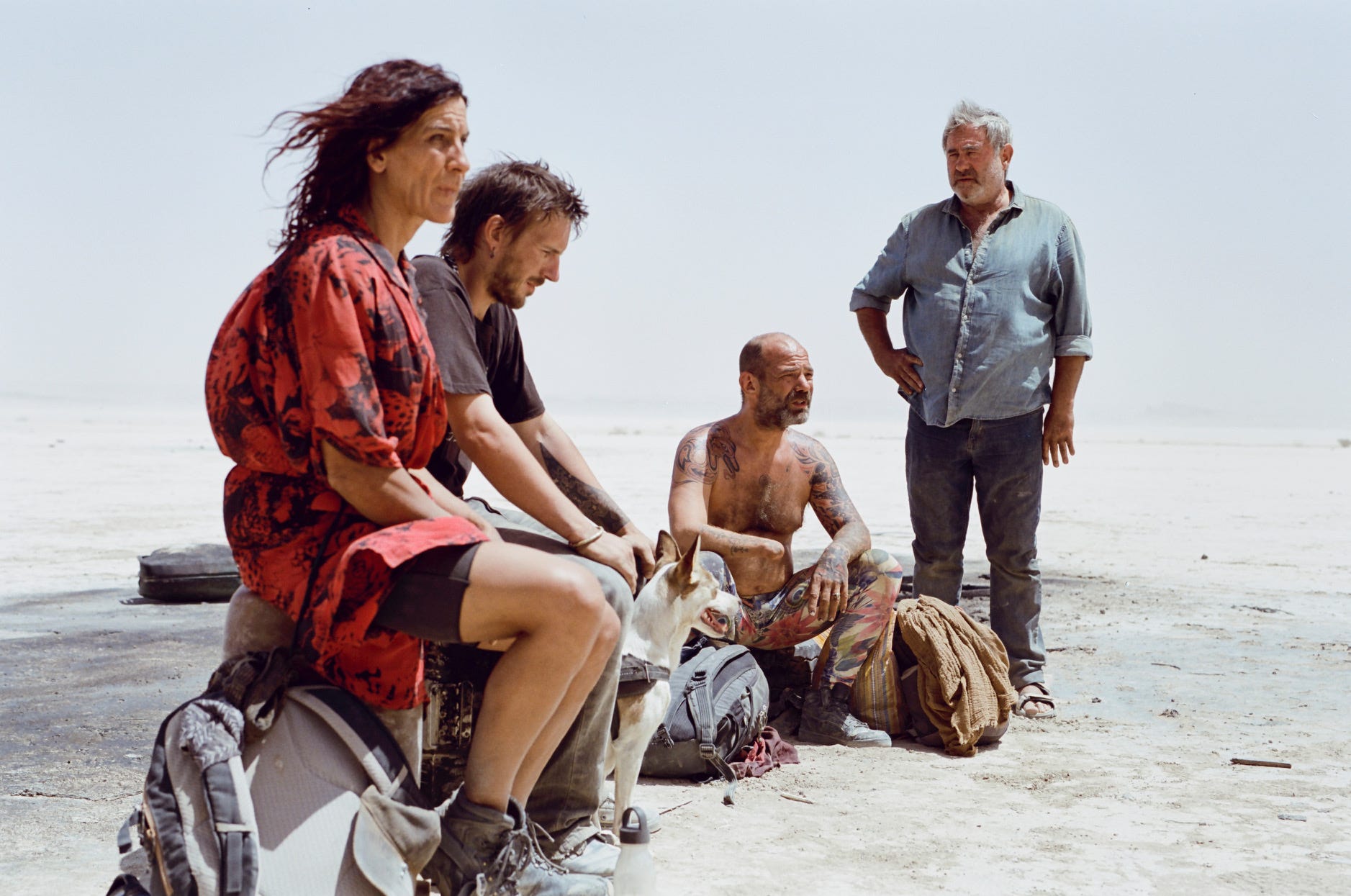

I didn’t quite know what to make of “Sirāt” when I first saw it. It was during the run-up to awards season at the end of the year, which can be a blur as critics like me cram movies at a hectic pace before voting deadlines. I remember I found it very odd and in some ways off-putting.
But it’s also stayed with me in a way other films from that frantic time have not.
It’s a trek through the desert with a gang of people who are hard to fathom. A collection of Europeans of various stripes, they are in Africa for a rave in the middle of nowhere. They arrive in rolling ramshackle vans and trucks, both conveyance and abode.
For days on end they will do drugs, listen to the repetitive pounding music that’s all beat and no melody, and shuffle about in a stuporous dance that more outwardly resembles the meanderings of horror movie zombies than creative souls reveling in their freedom. When the rave is over, they’ll pack up, drive to another part of the desert, and do it all over again.
These people don’t seem to have much purpose in life, at least to conventional eyes. But it’s the existence they’ve chosen, which is a family of folks who are lost, quite intentionally, and don’t want to be found.
Into this world intrudes Luis (Sergi López), a frumpy middle-aged dad with his son, Esteban (Bruno Núñez Arjona), who’s maybe about 10. He is looking for his teenage daughter, who ran off to join the rave circuit, and they have been following the various groups for months now. Amongst the people with mohawks, piercings, tattoos and other ornamentation, they are the weirdos.
Luis’ quest seems bizarre, even mad. Surely if his daughter had wanted to be found, she would have made contact by now. Bringing his son and their little dog to traipse about the desert in their aging minivan is just digging the hole deeper. (What about school? Work?) In their search to find that which is lost, they join with others who have made being untethered their ethos.
They eventually break off with a smaller group of ravers heading toward Mauritania for another gathering. It’s an arduous journey through the mountains and more desert, and there are hardships along the way. They share food and gas, help each other out of some scrapes, and slowly Luis and Esteban start to become accepted into this little clan.
They are an odd collection. None are particularly young or old, beautiful or homely, virtuous or loathsome. One guy, Tonin (Tonin Janvier), is missing a foot and another, Bigui (Richard Bellamy) is missing a hand. No one is really in charge but the women, Stef (Stefania Gadda) and Jade (Jade Oukid), seem to do the most directing of activities. Josh (Joshua Liam Henderson) does a lot of the driving and talking.
As you might guess from the names, none of the ravers are played by professional actors but are random folks found by director Oliver Laxe, who also co-wrote the screenplay with Santiago Fillol. Whatever they did, it works as the cast has an unstudied way about them, as if unaware of the camera.
I don’t want to get too much into what happens on this strange journey, other than to say things will bounce between euphoria and tragedy. At one point after some poor turns of events, they will decide to stop where they are and hold their own impromptu rave, setting up speakers for more of that deadening bass-driven chant.
It’s their solution to all problems, to lose yourself in the beat while tripping on substances. At some point you realize it’s akin to a religion, and they are on some mystical odyssey in which they travel a lot but go nowhere, instead descending deeper inside themselves and bonding to the few others who share this off-kilter spirituality.
About a half-hour into the movie, I was quite certain I would grow bored with this troupe and their pointless wandering. But I never did. Instead I found myself more engrossed as things went along, wondering why this collection of bedraggled figures commanded my attention so.
I was reminded a lot of William Friedkin’s “Sorcerer,” another hard-to-categorize movie in which huge, slapped-together trucks traverse an unforgiving terrain for reasons that seem mystifying.
A winner of the Jury Prize at Cannes (basically, second place for best picture) and an Oscar nominee for Best International Feature, “Sirāt” is a film that doesn’t fit into any neat categories or conceptions. We just follow these misfit group on their long, strange trip to nowhere, and marvel at how transformational the journey seems.