
The Choral
A heartwarming entry in the "communal English village do-goodism" genre, with Ralph Fiennes as the prickly conductor brought in to stage an ambitious production during World War I.

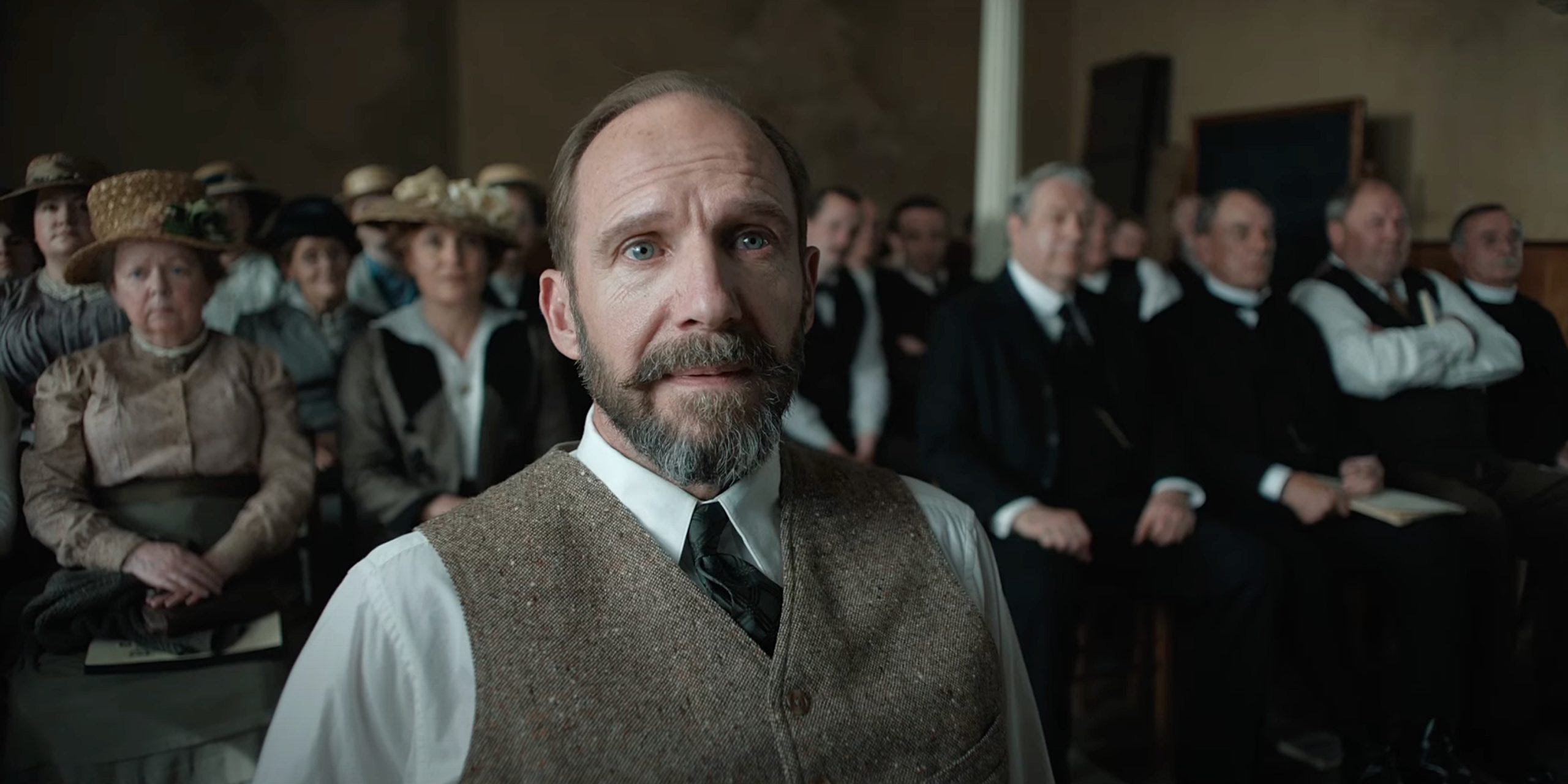

Ralph Fiennes is not a name one associates with heartwarming movies. This is a guy who broke out playing a Nazi concentration commandant and went on to personify evil itself in the Harry Potter movies. More recent roles have included a chef who murders his guests and an unhinged doctor/priest who collects and arranges human skulls.
So I was somewhat surprised at the premise of “The Choral.” Fiennes plays a prickly conductor brought into a remote English village to lead them in an ambitious oratorio performance (basically, an opera without the costumes and such). The story has tragic notes but is generally uplifting in tone.
It follows a fairly well-worn path: at first the provincials will reject the conductor for his snooty ways and shadowy past; there will be internal conflict and strife within the choral; they will gradually coalesce around a shared mission; and even rally to their formerly resented leader in the face of threats.
Switch it from singing to basketball, and this is “Hoosiers,” almost beat-for-beat.
Despite the lack of originality, it’s still a rich experience and a good film to greet the holiday season. Fiennes is at the center of the movie but he’s not really the star, as this is very much an ensemble picture. His character is dour and a bit tortured, but it’s like the bitter tang to an otherwise sweet morsel.
The setting is 1916 Ramsden, a medium-ish town in Yorkshire, and the war is ravaging the menfolk. Most are either deployed overseas, waiting to be called up by dint of age or lottery, or already returned wounded and maimed. Many more will never come back.
One teen boy’s job is to deliver the daily telegrams to the homes that have lost a soldier. His randy best friend tags along, musing about taking advantage of the widows’ grief to lose his virginity. There’s a subset of these lads in the story, almost a mini-Greek chorus, accepting they’re going to go off to war and probably die, but at least want to experience sex before they do.
The latest recruit is the choral’s director, so the town leaders are forced to improvise. Roger Allam plays Alderman Bernard Duxbury, who usually sings the lead tenor role owing to the fact his mill largely funds the group, rather than having a particular good voice. He’s a touch priggish but not truly a bad guy, just the sort who’s used to always having his way.
Mark Addy is Fyton, his good-natured wingman who’s doing solid business taking photographs of the soldiers before they go overseas. By contrast, Trickett (Alun Armstrong), the resident sourpuss, is seeing his undertaker trade suffer because so many are being buried on the other side of the English Channel.
Every year the choral puts on a big oratorio, but the problem is there aren’t enough men left to lend their voices — at least, the right class of men. Eventually Duxbury and the rest set aside their prim objections and start recruiting from the pubs and factories.
They debate who to bring in as choral master and eventually settle on a long-shot option: Dr. Henry Guthrie (Fiennes). He’s very well regarded but has a reputation of being stern and unbending. Even worse, he’s only recently returned to England after living and working in Germany for several years because he regards them as placing more importance on the arts.
“The English think music is social life just carried on by other means. I don’t,” Guthrie says.
There’s the recruitment phase of the story (screenplay by Alan Bennett, an Oscar nominee for “The Madness of King George”) immediately followed by the portion where Guthrie shocks the choral members by shaking things up. This includes making everyone audition for their roles, which upsets the old biddy contraltos who’ve been grandfathered in long enough to become grandmothers.
He also advocates for dumping the old staid “St. Matthew Passions” by Bach for a more modern piece, “The Dream of Gerontius” by Edward Algar. Guthrie writes to Algar seeking his permission to perform it, which leads to some ongoing speculation about whether the great composer (Simon Russell Beale) will attend the performance himself.
(This is ultimately a Christmas movie, so I’ll let you guess if that happens.)
Various subplots and complications occur. Mary (Amara Okereke), a devout young volunteer for the Salvation Army, is recruited to sing the female lead and has a heartbreakingly beautiful voice. She’s also Black, something the movie never comments upon, which I’ll chalk up to contemporary wishcasting as it’s hard to believe she would be immediately accepted.
Bella (Emily Fairn) is a young woman in the choral whose boyfriend, Clyde, is presumed dead overseas. She uses the opportunity to start dating one of the rough boys recently recruited.
It’s suggested that Guthrie and his assistant, Robert Horner (Robert Emms), are both gay but not a couple, as the elder man is pining for his own love lost in the war. Robert apparently wants more from the relationship, and is also facing his own impending draft into the military.
In a most delicate issue, Guthrie and Horner realize that Duxbury simply isn’t up to the task of singing the lead role. A surprise potential replacement (Jacob Dudman) presents himself late in the going, and they’re forced to navigate a situation where the man paying for the whole endeavor needs to be demoted.
The film was directed by Nicholas Hytner, who’s done some notable features (“The Crucible,” partnering with Bennett on “King George”) but has largely devoted himself to filmed versions of stage productions for the past two decades. It has wonderful costumes, settings and production values, giving the movie of feeling well-worn and comfortable.
I couldn’t help thinking how “The Choral” fits in with a niche but distinctive genre I’ll call “communal English village do-goodism.” These are movies set somewhere in the corners of the British isles where the townsfolk get together to accomplish some seemingly daunting and/or ridiculous task that will bring them all together. Examples include “The Englishman Who Went Up a Hill But Came Down a Mountain,” “Waking Ned Devine,” “Calendar Girls,” etc.
As I said, this is not really a Ralph Fiennes film, just a decent film with Fiennes in it. I don’t think I’m being insulting by saying you could have cast any number of other actors and the resulting movie would not have been much different. This is a “them” story, not a “him” story — one where no solo voice is dominant.