
Trifole
An bittersweet, evocative Italian drama about a young woman who has come to help her truffle-hunting grandfather gets lost in the weeds of a strange third act interlude.


One of the saddest experiences I have watching movies is when a film starts strongly, seems to be setting up for solid finale and then just loses itself somewhere along the way.
“Trifole,” an evocative and bittersweet Italian drama about a young woman who comes to help her truffle-hunting grandfather, is two-thirds of a lovely picture. Unfortunately, it wanders away from itself in the third act on some cockamamie swerve.
It’s rough. At first I thought the interlude would just be a momentary departure, a wobbly attempt to inject some chase-chase action intrigue into the mix. But it. Just. Kept. Going.
You see this in American movies a lot. It’s a slow, sentimental story that centers on characters rather than plot, and some producer or other nimrod says, “We’ve gotta speed things up, you’re losing the audience.” When in fact that audience was right there with you, enjoying the languid tempo.
The Italians, of course, are well known for their cherishing of the simpler things in life — food, music, wine, family. Their cinema has reflected that, too.
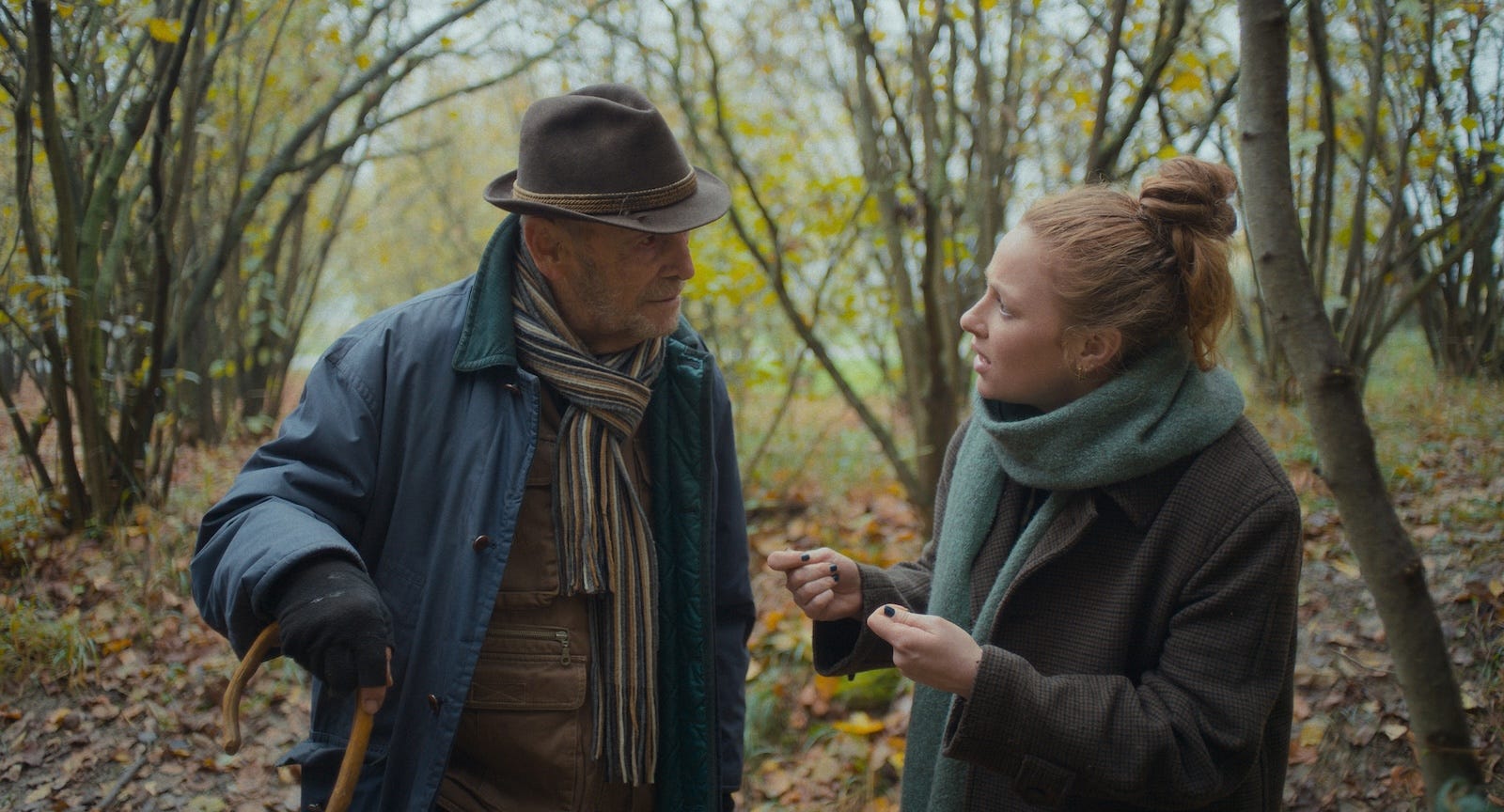
Ydalie Turk stars and also co-wrote the screenplay with director Gabriele Fabbro, playing Dalia, a woman in her early or mid 20s. She is Italian but has lived most of her life in London, and is one of those people who hasn’t yet discovered their purpose. A washout in college, she’s been more or less ordered by her mother, Marta (Margherita Buy), to take care of her grandfather, Igor (Umberto Orsini).
He’s living on the outskirts of the town of Alba in a ramshackle house surrounded by vineyards. Upon arriving, Dalia calls it beautiful, but the vista is baleful to Igor’s eyes. All this land, he explains, was once forest celebrated for its truffles. He’s behind on his mortgage and the wine people are eager to push him out.
Igor is clearly not all there. At first he thinks Dalia is Marta. Later when she holds up the phone with a video call from his daughter, Igor cannot understand that she is not actually present. Later episodes seem to indicate he’s sliding into the middle stages of dementia.
His ability to hunt truffles, though, is undiminished. Accompanied by his beloved dog, Birba, they comb the countryside uncovering these little jewels under the ground. Igor makes do from selling his finds and a few vegetables on the side, but we sense it’s the pure joy of the search itself that sustains him.
“To love this land means to not be alone,” he says.
At first Dalia struggles to connect with her grandfather. She hasn’t seen him since she was little and her Italian is a tad rusty. She also doesn’t care for his observation that she’s a “lost” person — though he promises it won’t be a permanent condition.
This seems to come true as things move on. Igor grows a little friendlier, Dalia sees the purity of this seemingly austere sort of life, and she takes more of an interest in truffles. Igor is stubborn to reveal the secret of his methods, which seem to involve as much faith as science, claiming it’s the lightning of the god Jupiter that makes the truffles grow.
I’ll pause here to admit that truffles, like wine and some of the other things celebrated by the frou-frou crowd, pass way over my head. Maybe I’ve a mutant palate but they just don’t taste good to me. But in select circles truffles are prized (and priced) like gold, due in part to the inability to consistently cultivate them. Truffle hunting is an endeavor unto itself.
The cinematography by Brandon Lattman skillfully shows off the lush beauty of the Italian countryside, and music by Alberto Mandarini helps sustain a mood that is a wintry mix of sadness and sentimentality. It’s a feast for the senses.
And then…
Well, I’m not going to go into detail about my disappointment, leaving that for you to discover yourself. Suffice to say Igor is injured during a solo trip he stubbornly goes on, and finally places his trust in Dalia to search on his behalf for the mythic white truffle he’s been searching for all his life. That’s when things go awry.
At one point, Dalia finds herself dressed as a medieval princess dashing around the city in the midst of a media frenzy; I felt like a different movie had swallowed the one I had been watching.
It’s such a shame. I was really bathing in this story about Dalia and Igor, two people trapped by different forms of isolation, warming up to each other at the end of one life and the launch of a young one. The lead performances lend a sense of discovery leavened by the trauma they have experienced.
And then, poof.
Making movies is a lot like truffle hunting. You dig around in a quest to find something rare and beautiful — but sometimes all you’re left with is a mess.