
Nuremberg
Rami Malek and Russell Crowe chew scenery while facing off as an infamous Nazi leader and the psychiatrist tapped to study him in this showy, effective based-on-true drama.

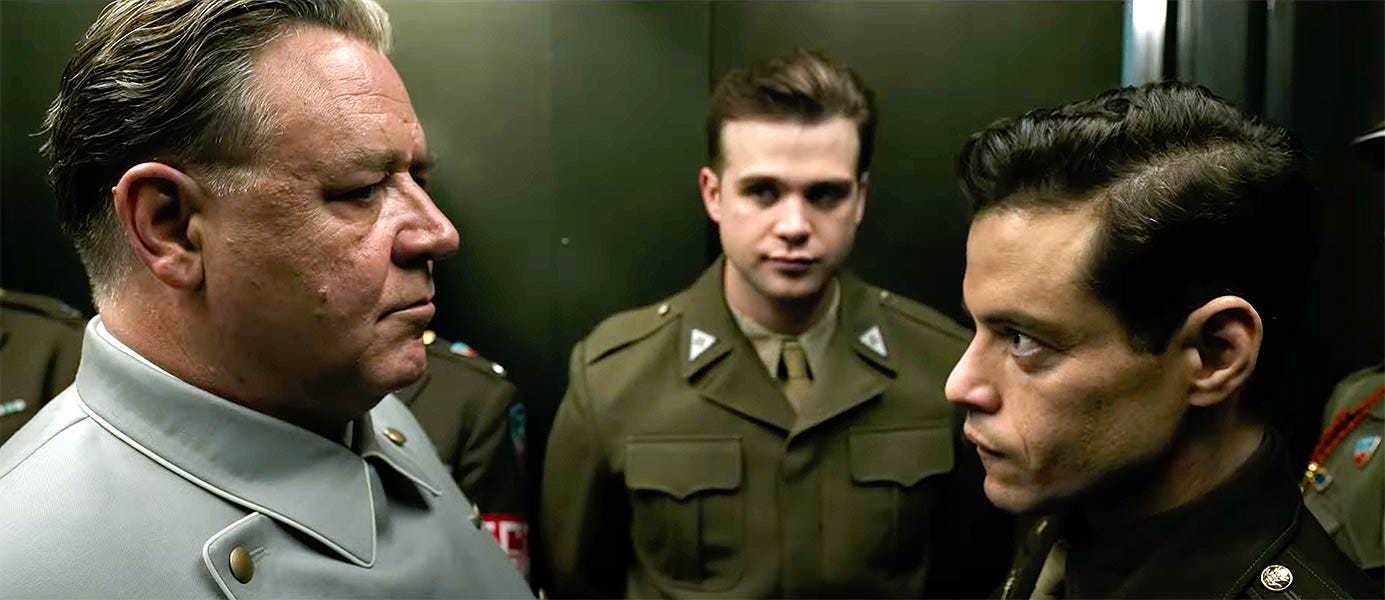

Editor’s note: This review previously ran as part of Heartland Film Festival coverage; we’re reposting it timed with its regular theatrical release.
There’s a certain schmaltzy showbiz self-awareness to “Nuremberg,” the new based-on-true drama about the famous Nazi trials of 1946, in which the senior leaders of the German Third Reich were called to account for their grisly war crimes.
You can tell right from the opening scene, where Rami Malek plays Douglas Kelley, a brash young psychiatrist riding on a train in post-war Germany. He pretends not to notice the beautiful woman sitting opposite him, nonchalantly shuffling a deck of cards in one hand. Finally he turns to her and impresses her with magic tricks, a thousand-watt smile splayed across his churlish face.
It’s a classic Hollywood character introduction: Check me out, folks — I’m hot sh*t.
Same goes for his screen nemesis, Russell Crowe as Hermann Göring, Reichsmarschall of the Third Reich and Adolf Hitler’s #2 man. Driving through a crowd of fleeing people on the last day of the war in Europe, not even trying to hide his status in a limousine with swastika flags, he is stopped by American soldiers with Tommy guns. Cool and collected in contrast to their nervous trigger fingers, he calmly emerges from the car and demands they unload his luggage.
The next 2½ hours will be spent watching these two splendid, Oscar-winning actors chew scenery and play off each other as their characters do psychological battle in Göring’s prison cell. There’s a certain flavor of “Silence of the Lambs,” of course, with the German general as the super-intelligent locus of evil and the shrink as the somewhat naive innocent who thinks he can match wits with him.
The film is written and directed by James Vanderbilt, a purveyor of largely mainstream entertainment like some of the “Scream” movies and “White House Down,” but also co-writer of the snake-y smart “Zodiac.” It’s based on a 2013 book by Jack El-Hai chronicling the actual relationship between Kelley and Göring, something largely lost to history.
Kelley is recruited to study Göring and 21 other high-ranking German officers as they are prepared for the first-ever international trials for war crimes. The main concern of the military brass (John Slattery plays the general in charge of the prison) is that the Germans will commit suicide and rob the whole affair of its legitimacy. They also want to ensure the Nazi ethos is exposed for all its depravity and put to rest forever.
On the legal side, there’s great concern that if Göring or the others manage to beat the charges, the whole thing will come tumbling down like a house of cards.
Michael Shannon plays Robert Jackson, a U.S. Supreme Court justice who is selected to lead the prosecution. He’s a smart, straight-arrow type… possibly too straight to pierce the web of lies and obfuscation churned up by Göring, who claims the (conveniently dead) Hitler and Heinrich Himmler were the real architects and executors of the concentration camps that claimed 6 million Jews.
So in addition to keeping the German officers alive and talking, Kelley’s side gig is to feed information to Jackson that will be helpful at the trial. There’s some discussion, quickly glossed over, that they’re violating the ethics of their respective professions with this collaboration. Richard E. Grant plays David Maxwell Fyfe, the British prosecutor who joins their little cabal.
Kelley immediately senses the opportunities, both personally and professionally. He begins taking copious notes so that he can pen a best-selling book and make a name for himself as a sort of heroic pop psychologist.
“What if you could dissect evil?” he asks Howie Triest, the true-blue sergeant assigned to assist him. He’s played by Leo Woodall, who gets some unexpectedly meaty scenes of his own that he knocks out of the park.
I can’t say as the script is structured particularly well. There are several supporting characters that could easily be written out of the movie, such as Colin Hanks as a competing psychiatrist brought in to question Kelley’s conclusions. And the movie starts in such a way as to suggest Shannon will be the third leg of a character triangle, but then he quickly gets shunted to the background until it’s time for some speechifying at the trial.
The real meat, though, is the relationship between Kelley and Göring. The doctor goes out of his way to charm the general, who seems to swallow the act whole. Kelley helps him through a medical episode, which seems to build a great deal of trust. Soon Kelley is ferrying letters between Göring and his wife (Lotte Verbeek), living in exile with their daughter.
It’s even suggested they have become friends — though we sense each man is only showing part of his hand.
Crowe makes for quite a picture as Göring. Mammoth in his pale blue uniform, which he insists on continuing to wear even stripped of his medals and insignia, he seems to dominate every room — even sitting in the defendants’ box, his life on the line.
The idea with Malek’s character is the audience is supposed to be first charmed by him, then see through his shtick, perhaps even begin to think he’s kind of a dick, then celebrate when he finally shows his mettle and does the right thing.
Though it relies heavily on formula, “Nuremberg” is still a very entertaining movie — part history, part razzmatazz.